- Back
- Back
- Back
- Back
- Back
- Back
- Back
- Back
- Back
- Back
The Medicines and Healthcare products Regulatory Agency (MHRA) has launched a consultation on proposals to update the statutory fees it charges for regulatory services from 1 April 2027.
The consultation seeks views on changes intended to enable the MHRA to recover the costs of delivering its regulatory services, while investing in faster, more reliable, and more predictable services.
BHTA members are encouraged to review the proposals and share evidence on how the changes could affect their organisations.
The BHTA will also be responding to this consultation on behalf of its members. Read the BHTA’s responses to previous government consultations here.
The MHRA receives around 80 percent of its income from statutory fees, which are charges for regulatory services such as medical device clinical investigations, regulatory advice, and post-market surveillance. Fees are set on a cost-recovery basis, and the MHRA regularly reviews them against the cost of providing its services.
Key proposals include:
Of particular relevance to BHTA members involved in medical devices is the annual post-market surveillance (PMS) registration fee. The MHRA proposes increasing this from £300 to £511 per chargeable Global Medical Device Nomenclature (GMDN) Level 2 category, a rise of 70 percent, from 1 April 2027.
The fee funds the MHRA’s strengthened post-market surveillance activities, including reviewing adverse incident reports, field safety corrective actions, and other vigilance data. The MHRA had previously proposed moving to full cost recovery in 2027/28, but is now proposing to retain partial government subsidy during 2027/28 and 2028/29 to reduce the immediate impact on manufacturers, including SMEs.
The consultation also proposes enhanced support for eligible UK-based SMEs developing innovative products. This would operate through a waiver or voucher mechanism covering the full cost of eligible fees, subject to qualifying criteria and an annual scheme cap of £2 million.
Given the range of proposed changes, BHTA members are encouraged to review the MHRA’s full consultation document, including the tables of current and proposed fees in Annex B, to identify the changes relevant to their organisations and consider the potential financial and operational impact. The consultation specifically invites evidence on the impact of fee increases on market activity, innovation, and production, as well as views on the PMS fee, SME support, and individual fee adjustments.
Read the MHRA consultation on statutory fees 2026, including the full consultation document and detailed fee tables.
Complete the MHRA online consultation survey.
The consultation closes on 25 September 2026.
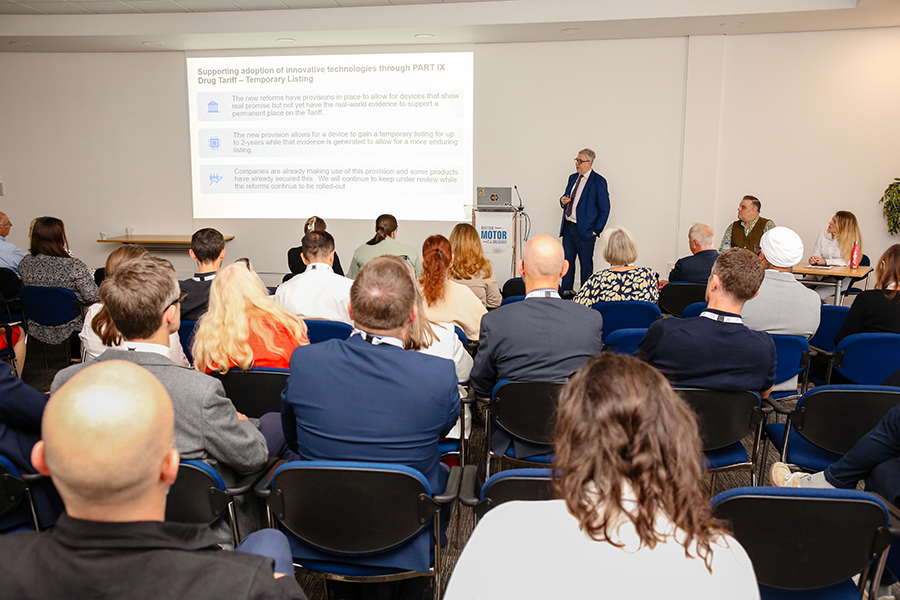
A keynote session at the BHTA Joint Section Meeting on 18 June 2026, at the British Motor Museum in Warwickshire, explored the latest developments across the UK Government’s MedTech agenda.
The session was presented by Paul Griffiths, Head of Policy and Strategy for Medical Technology & Innovation at the Department of Health and Social Care (DHSC).
Opening the session, Paul highlighted the arrival of new ministers, including James Murray, Secretary of State for Health and Social Care, and Preet Kaur Gill, Minister for Life Sciences and Innovation.
He said the key message from the new ministerial team was the continuation of existing direction and priorities.
Wave One of the new Part IX process is now underway, with applications having closed in March and assessments being carried out by independent advisory panels.
Paul noted that a review will take place following the first wave to assess how the process is working in practice and identify any unintended consequences before future waves are introduced.
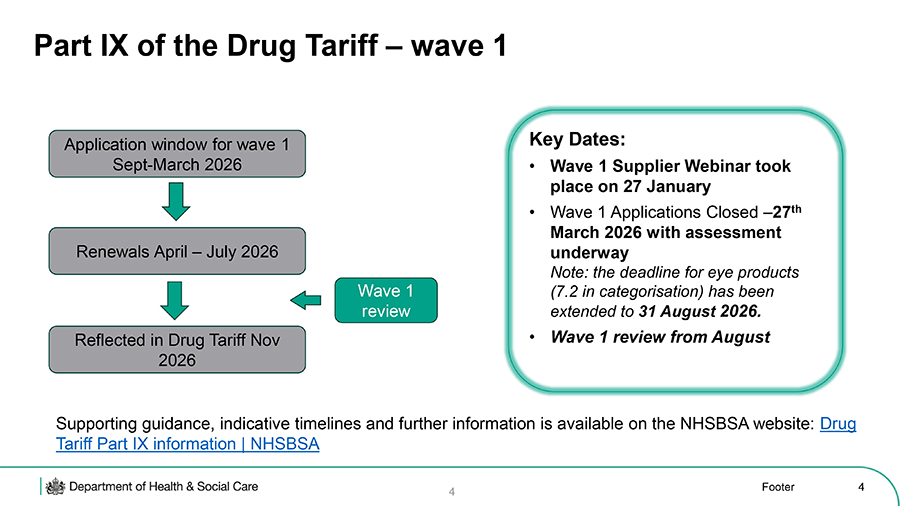
He also highlighted the introduction of temporary listings for products that demonstrate strong potential but require additional real-world evidence before being considered for permanent inclusion. The provision allows products to be listed for up to two years while further evidence is generated.
Paul said several companies are already making use of the temporary listing route, which has been introduced to help innovative products reach patients sooner while supporting further evidence generation.
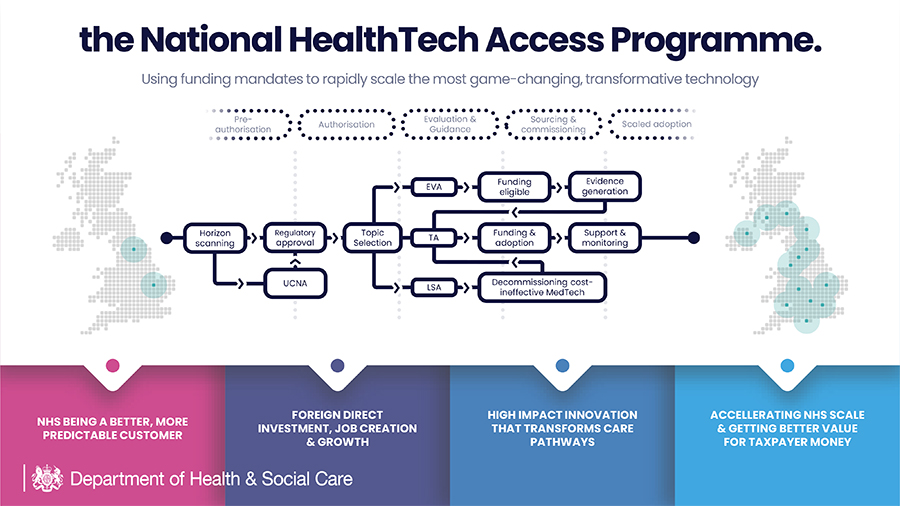
Members also received an update on the National HealthTech Access Programme, formerly known as the Rules-Based Pathway.
The programme aims to create a clearer route from regulatory approval through to evaluation, reimbursement, and NHS adoption. The first technologies have now entered the NICE Technology Appraisal process.
Paul said the programme is intended to make the NHS a more predictable customer for innovation, supporting both technology adoption and growth across the UK’s life sciences sector.
Following engagement with more than 300 SMEs and extensive work with NHS organisations, industry representatives, and other stakeholders, the government published guidance on value-based procurement for medical technology in June.
The approach has been tested through pilot projects at 13 NHS trusts, with an independent evaluation examining how the methodology performs in live procurement settings and what support organisations may need to implement it more widely.
Paul said the next phase will focus on training, implementation support, and adoption across NHS organisations.
Paul provided updates on Design for Life, the programme supporting the transition towards a more circular approach to MedTech.
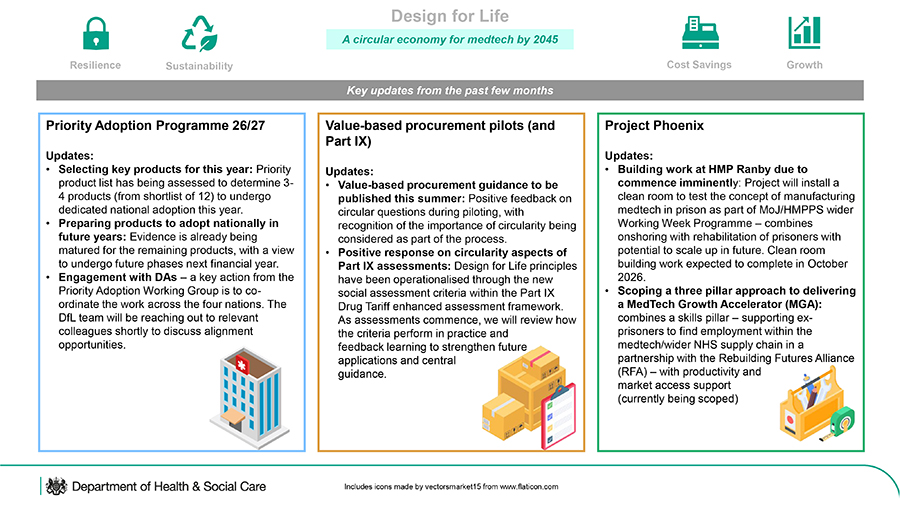
Work is continuing on priority adoption programmes, with sustainability considerations being incorporated into wider decision-making processes.
Alongside this, he outlined progress on Project Phoenix, which is developing a clean room in HMP Ranby to test the concept of manufacturing MedTech in prisons.
Another programme highlighted during the session was MedTech Compass, a DHSC-led platform designed to help NHS organisations compare products using trusted evidence sources.
The platform will bring together information from NICE guidance, pilot evaluations, procurement exercises, and other datasets to support purchasing decisions. The programme entered beta development in June.
Paul also noted that Compass has been identified as the delivery vehicle for the Innovator Passport programme, helping to support more consistent adoption of technologies across the NHS.
The session concluded with an update on several areas of regulatory reform.
Paul highlighted progress on pre-market regulation changes, which are moving through the final stages of development. He also discussed ongoing work around international recognition and reliance pathways, following consultation with industry and other stakeholders.
Paul also highlighted forthcoming recommendations relating to AI as a medical device.
Members also heard about ongoing discussions regarding industry payments disclosure. A series of stakeholder workshops has been taking place to explore different options and gather views from industry, patient groups, and NHS organisations before decisions are taken on next steps.

The Medicines and Healthcare products Regulatory Agency (MHRA) has published proposed new pre-market regulatory requirements for medical devices and in vitro diagnostic (IVD) devices entering the Great Britain market.
The draft Medical Devices (Amendment) Regulations 2026 were published on the World Trade Organisation (WTO) notification portal on 8 May 2026, opening a formal period for feedback from stakeholders across the medtech sector.
BHTA members are encouraged to share their views on the proposed regulatory changes through the MHRA stakeholder impact survey. Member feedback will help inform the MHRA’s Impact Assessment and future implementation planning.
According to the MHRA, the proposed changes are intended to introduce a more proportionate and patient-centred regulatory framework for medical devices and IVDs.
Key proposals include:
The MHRA states that the proposals are designed to support patient safety, improve transparency and strengthen access to innovative medical technologies across the UK.
The proposed reforms may be particularly relevant to members involved in manufacturing, importing, distributing, supplying, or servicing medical devices and IVDs. The survey is intended to gather evidence on the practical impacts of the proposals, including likely costs, benefits, and implementation considerations. As the MHRA develops its future regulatory framework, feedback from across the sector will play an important role in helping policymakers understand the potential operational, commercial, and compliance impacts of the proposed changes. Members responding to the survey are encouraged to provide specific examples relevant to their organisations where possible. All responses will be analysed in aggregate and anonymised.
Read the WTO notification and draft Medical Devices (Amendment) Regulations 2026.
Complete the MHRA stakeholder impact survey.
The deadline for responses is 11:59pm (UK time) on Friday 19 June 2026.