
- Back
- Back
- Back
- Back
- Back
- Back
- Back
- Back
- Back
- Back

At the recent joint British Healthcare Trades Association (BHTA) and AXREM conference, David Lawson, Director of Medical Technology and Innovation at the Department of Health and Social Care (DHSC), set out the evolving landscape for medical technology.
‘The Future of MedTech – Innovating for Tomorrow’ conference was held on 13 May 2025 at The Mercure, Northampton.
David’s presentation was the final part of a compelling conference talk titled ‘Big Picture: What is the Future Policy Landscape for Medtech?’. The previous speaker, Nata Zaman, discussed NHS England’s New Hospital Programme and what that means for medtech.
David reflected on the MedTech Strategy alongside and some of the upcoming and ongoing DHSC initiatives that are crucial to medtech businesses across the UK.
Despite the frequent changes in ministers and departmental structures over the past few years, the original challenges identified in the MedTech Strategy remain highly relevant: supply resilience, innovation adoption, data infrastructure, and markets.
With the NHS under significant pressure and few easy options to increase funding or expand the workforce, medtech is increasingly seen as a key lever for transformation. Innovation adoption is not just a priority for healthcare delivery; it’s also vital to the success of the broader Industrial Strategy, where life sciences remains one of the UK’s “crown jewels”.
Technology as a solution to transform healthcare will also likely be flagged in the upcoming 10-year health plan, David noted.
David highlighted the importance of value-based procurement as a mechanism to support consistent decision-making and better uptake of technology. He acknowledged the lack of standardisation currently affecting procurement: “We don’t today have any standard of how medical technology should be assessed… so we shouldn’t be surprised when we see huge variation”.
To address this, the DHSC has been co-developing a simplified methodology – described as a “ladybird guide to procurement” – that incorporates a 40/60 weighting in favour of quality over price. It includes domain-based question banks for local teams to select from, offering clarity for both buyers and suppliers. Shadow testing is already underway with eight procurement teams, and a national launch is planned for January 2026.
A major development currently in progress is the DHSC MedTech Compass, which is described as “a single source of information where there’s visibility of products within categories and information on the various attributes of those products”.
David acknowledged the challenges SMEs face in getting products in front of decision-makers across the country: “People may not be aware that actually you have a product because SMEs don’t have the resource to be able to go around the whole country to make everyone aware.”
The Compass aims to not only showcase available technologies but also introduce a ‘passporting’ function to reduce repetitive data submissions about the same technologies to NHS trusts. Having completed its discovery phase, the project is now entering its alpha design stage this summer, with beta testing expected in 2026.
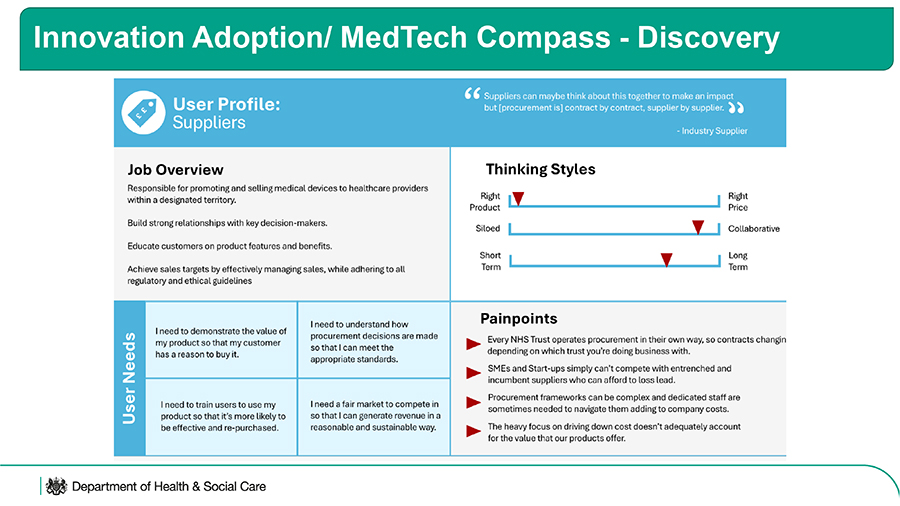

Crucial to both the Compass and the wider ambition for smarter regulation and procurement is a Product Information Management (PIM) system. As David noted: “We don’t have a single version of truth in terms of medical devices.” Poor data quality is hampering post-market surveillance regulatory requirements and innovation uptake.
The PIM is now entering its beta build phase. A private beta involving industry and health partners will follow shortly, ahead of a full public launch in January 2026. David stressed that the PIM will underpin future initiatives, including a more “risk-proportionate” regulatory approach from MHRA.
On the topic of the Part IX Drug Tariff, David acknowledged its complexity: “I describe Part IX like an onion. You peel a layer, and then suddenly another layer appears”. After extensive work to modernise categories and introduce logical groupings, a new scoring framework will be implemented this month.

A new temporary listing process will allow products with emerging evidence to be included on the tariff while further data is collected. David also flagged future work on local formularies, noting the lack of national guidance and the inconsistent practices this leads to: “There are certain parts of the country that [suppliers] don’t bother engaging with because of the approach that they take”.
A forthcoming report from National Voices, drawing on input from over 650 patients, will help ensure future categorisation and procurement processes better reflect patient priorities and lived experiences.
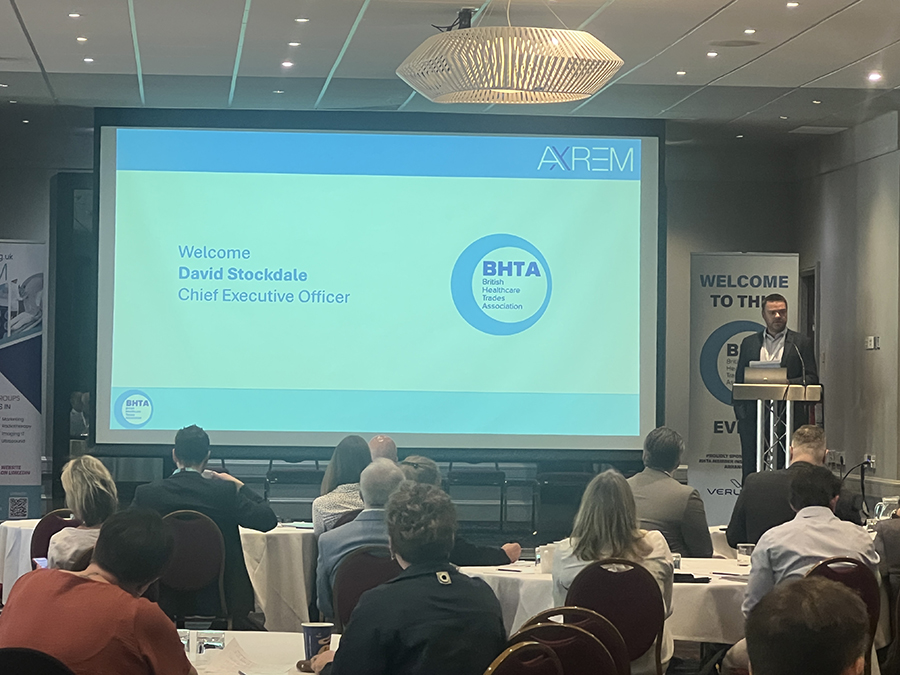
On 13 May 2025, the British Healthcare Trades Association (BHTA), in coordination with AXREM, hosted a conference about the future of medtech, offering valuable and informative talks for attendees.
‘The Future of MedTech: Innovating for Tomorrow’ brought together BHTA and AXREM members to hear from senior leaders and experts from across the NHS, DHSC, MHRA, and more to explore the latest advancements and strategies in medtech.
Taking place at the Mercure Northampton, delegates had the chance to network with industry peers, get involved in engaging panel discussions, and learn about some of the most important topics in the medtech sector today.
Engaging presentations throughout the day included topics on sustainable procurement, how suppliers can meet the NHS’ net zero targets, the economic outlook for UK manufacturers, the future regulatory framework for the UK medtech sector, the DHSC’s upcoming work on building a MedTech Compass, and more.
Speakers throughout the day were:
The Future of MedTech conference has received positive feedback from attendees.
Shona Macdonald, Director of Market Access & Reimbursement, UKI, at Convatec, commented: “The BHTA and AXREM conference proved to be a highly relevant and extremely interesting agenda. It provided me with an invaluable opportunity for networking and engagement with stakeholders and peers.
“I was particularly encouraged to hear that collaboration with industry through the NHS transformative changes is both invited and welcomed by the system.”
David Dawson, Market Access Director, UK/Ireland for BD, said: “I found the BHTA conference both interesting and informative. The varied subject matter and speakers provided a good mix of important issues. I especially enjoyed the afternoon presentations and panel discussion.”
Diane Hargrove, Sales Director at BES Healthcare, stated: “I thought the quality of the speakers was excellent, and it was refreshing to hear that there seemed to be an understanding of some of the real challenges that face industry in bringing new innovative technologies through to the healthcare market.”
Richard Holland-Oakes, Co-Founder and CEO of Recare, noted: “Certain parts of the day were very interesting with the NHS and social services and the government finally trying to work together.
“I must say it appeared the presentation to be more hospital-related savings with the AXREM companies rather than the companies of BHTA and the products of which you support, NHS/community and the private sector and of which our products are bespoke to the individuals requirements, and of these products that are prescribed from the hospital environment for home use is a hard to manage and deliver a better service and savings without changing this structure that is in place at present. But it can be done!”