- Back
- Back
- Back
- Back
- Back
- Back
- Back
- Back
- Back
- Back
The British Healthcare Trades Association (BHTA) has responded to a consultation seeking views from relevant stakeholders about the UK’s medicines and medical device regulatory framework.
Conducted by the Medicines and Healthcare products Regulatory Agency (MHRA), in collaboration with the Department of Health and Social Care (DHSC), the consultation focused on the legislation that govern the development, authorisation, supply, and oversight of medicines and medical devices in the UK. These include the Medical Devices Regulations 2002 and the Medical Devices (Fees) Regulations, which are relevant to BHTA members.
Ahead of the 19 September 2025 deadline, the BHTA invited members to share their views so that they could be included in the BHTA’s response to the consultation.
Read the BHTA’s full consultation response here.
“We strongly recommend extension of CE‑marked products in perpetuity, beyond the current 2028/2030 transition periods. The economic reality of the UK’s global market position means that patients, clinicians, and large commissioners (the NHS) will benefit most from continued acceptance of CE-marked products (which provides the most effective route to market for global/multi-national companies) AND a clear, robust, well-resourced domestic assurance route for UKCA-marked products (which provides the most effective route to market for UK-based SMEs who supply primarily (or only) the UK market).”
BHTA welcomes the intent of the medical device regulations but notes that recent uncertainty has affected companies and, ultimately, patients. Members have reported operational challenges stemming from shifting timelines for continued acceptance of CE-marked products, evolving fee structures, and a lack of clarity around the respective roles of MHRA and UK Approved Bodies.
“Businesses need predictability, appropriate advance notice, and clear regulatory pathways in order to invest confidently.”
BHTA’s view is that the regulations are broadly fit for purpose; however, MHRA resourcing and service performance must keep pace with regulatory demands. Increases in fees should be matched by measurable improvements in timeliness and quality of service delivered by the MHRA.
“Timely production of indicative fees, well before 01‑Apr‑26, will be essential… [and] quarterly or monthly payment plans for UKRPs… will be essential.”
BHTA recognises MHRA’s work towards an algorithm-based post-market surveillance cost-recovery model using GMDN level 2 categories. To help businesses plan, the association urges early publication of indicative fees well ahead of the model’s commencement on 1 April 2026.
Flexible payment options, such as quarterly or monthly plans for UK Responsible Persons acting for multiple manufacturers, would ease the transition. Any changes should be accompanied by transparent, public performance metrics and consistent delivery.
Greater clarity is required on the division of responsibilities between MHRA and UK Approved Bodies, particularly as international recognition (IR) routes are developed. BHTA supports IR in principle, but asks for timely, practical guidance on how any additional information will be collected, assessed, and used by the regulator and Approved Bodies, to avoid duplication and delay.
BHTA also advocates for closer alignment with trusted international regulators to reduce duplicative evidence requirements and restore the UK’s attractiveness as a launch market. In this context, the association supports making CE mark recognition permanent for medical devices in the UK without a time limit to stabilise supply chains, avoid unnecessary duplication, and maintain effective access.
“By aligning regulatory procedures and decision-making with international standards, the UK can offer businesses greater predictability, minimize duplication of evidence requirements, and accelerate product entry into the market. We firmly support the continued acceptance of CE-marked medical devices in the UK without a time limit.”
“The existence of separate legislation for medical devices in Great Britain and Northern Ireland creates an unnecessary burden. Differing requirements and duplicated regulatory submissions add complexity, raise compliance costs, and discourage innovation. This regulatory split can delay the availability of new devices in one or both regions, without delivering any clear improvements in safety or quality.”
In response to the MHRA’s question about unnecessary and excessive regulatory burdens, the BHTA also calls for improved access to expert, ‘actual-human’ advice alongside digital portals, so registrants can resolve complex issues more efficiently without ad-hoc escalation.
BHTA further supports DHSC/MHRA work to enable reuse of appropriate single-use Class I medical devices, where safe, as part of a pragmatic approach to sustainability, cost control, and patient access.
“Keeping regulatory detail to a minimum while expanding on it within guidance allows MHRA to respond more rapidly and effectively.”
To keep pace with technology and public health needs, BHTA favours placing more technical detail in guidance rather than in legislation. Guidance can be updated more rapidly, allowing regulators and industry to respond quickly while maintaining safety. The association also encourages early and continuous engagement with stakeholders in the development of guidance, reflecting lessons from the pandemic period when temporary flexibilities were introduced without major issues.
Our response: New regulations made under the Medicines and Medical Devices Act (MMDA)
“The shift to a cost‑recovery model occurred while MHRA was dealing with significant backlogs… any fee increases should be accompanied by more consistent and prompt delivery of MHRA services.”
The BHTA has engaged with several statutory instruments made under the Medicines and Medical Devices Act, including changes to fees and extensions for CE-compliant devices in Great Britain. Operation to date is assessed as ‘somewhat effective’. However, the shift to cost recovery coincided with backlogs, underlining the need for clear communication, adequate resourcing, and stronger performance management. Any fee increases should be accompanied by timely services and enhanced staff capability.
“We strongly support MHRA’s recent renewed openness to engagement with industry, and to proactive collaboration.”
The BHTA emphasises that MHRA having ongoing dialogue with industry and patients will help ensure that regulation and guidance are workable, support innovation, and maintain safe access to medical technologies.

The Medicines and Healthcare products Regulatory Agency (MHRA) has opened a call for evidence on how it should prioritise the designation of standards for medical devices in Great Britain, to inform future work under the Medical Devices Regulations (MDR) 2002.
The exercise focuses on device standards used for medical devices placed on the Great Britain market. It invites views on the current list of designated standards and asks stakeholders to identify further standards that could be considered for future designation.
The MHRA states: “Designated standards are specific standards that have been officially recognised by regulatory authorities in the UK as providing a presumption of conformity with the essential requirements of relevant regulations.
“When a device complies with a designated standard, the device meets relevant essential requirements the standard addresses.”
The questionnaire requests factual information on how organisations use device standards in practice, and invites detailed suggestions about the content of the designated list.
Examples include:
The survey also asks respondents to rate the practical value of designated standards for market access; for example, whether using designated standards provides time savings in submission and approval processes, and whether mappings to essential requirements are useful.
This activity forms part of the MHRA’s wider programme to develop the future regulatory framework for medical devices in Great Britain, aiming to prioritise patient and public safety, maintain access to needed technologies, and support innovation. Input gathered through this exercise will inform how the agency prioritises future work on designation.
For organisations engaged in standards and regulatory compliance, the consultation focuses on which medical device standards are relied upon to demonstrate conformity, and where changes to the designated list could improve alignment with current practice. Designated standards remain a recognised route to demonstrating compliance with essential requirements in Great Britain.
The deadline for responses to the MHRA’s open consultation is 30 September 2025. Respond online here.

The Medicines and Healthcare products Regulatory Agency (MHRA) has published an updated response to its consultation on statutory fees for medical devices, confirming that a new annual registration fee to support post‑market surveillance (PMS) activities will take effect from 1 April 2026. This article summarises the changes for BHTA members.
From 1 April 2026, an annual medical device registration fee will be charged per Global Medical Device Nomenclature (GMDN) level 2 category under which a manufacturer has registered products. Where no level 2 exists, level 1 will apply.
The MHRA has confirmed that this new fee will replace the current one‑off medical device registration fee and will be calculated on the categories recorded on 1 April each year, with pro‑rata charges for any new categories added mid‑year.
The MHRA has indicated an estimated amount of £300 per category from 1 April 2026 per GMDN level 2 category (or level 1 category where no level 2 exists), and has noted that approximately 60 percent of manufacturers are expected to pay a single charge.
See the updated response, published 2 September 2025, for more information: ‘MHRA consultation on statutory fees — proposals on ongoing cost recovery: updated government response’.
The one‑off device registration fee remains in place until 31 March 2026. Current schedules, including the £261 medical device registration fee, are set out on the ‘Current MHRA fees’ page.
In its original consultation, published on 29 August 2024, the MHRA proposed an annual medical device registration charge modelled at £210 per GMDN code to fund PMS activities. Feedback from industry, including trade associations, questioned affordability and fairness across different device portfolios.
The revised approach, set at GMDN level 2, is intended to distribute costs more equitably while maintaining patient safety and supporting innovation. The consultation documents and background are available at ‘MHRA consultation on statutory fees — proposals on ongoing cost recovery’ and in the original consultation paper ‘MHRA consultation on statutory fees’.
Under the updated model, a manufacturer will pay once per relevant GMDN level 2 category for the charging year from 1 April to 31 March. If additional categories are added during the year, the charge for those categories will be applied on a pro‑rata basis for the remainder of the year.
Before billing begins, the MHRA will invite manufacturers to take part in a data‑cleansing exercise so they can remove obsolete or withdrawn products from the register without charge. Further guidance will be published by the MHRA to explain scope, billing mechanics, and preparation steps, according to the organisation.
The MHRA has stated that fees will continue to be paid through the Device Online Registrations System (DORS). BHTA members should ensure internal payment processes are ready for the new annual billing cycle.

At the recent British Healthcare Trades Association (BHTA) and AXREM conference, Dr Rob Reid, Deputy Director of Innovative Devices at the Medicines and Healthcare products Regulatory Agency (MHRA), delivered the first part of a pivotal talk titled ‘Regulation in the Medtech Sphere’.
Titled ‘The Future of MedTech – Innovating for Tomorrow’, the conference was held on 13 May 2025 at The Mercure, Northampton.
Rob’s presentation provided valuable insights into the UK’s evolving regulatory landscape and what medtech companies must prepare for in the coming months and years.
The UK’s current regulatory framework, the Medical Device Regulations (MDR) 2002, is outdated and in need of an update, Rob explained. MHRA’s regulatory update aims to align the UK’s framework with advances in technology, international standards, and recommendations from the Cumberlege review.
Central to the reform effort are three priorities: public and patient safety, support for innovation and growth, and closer alignment with international regulatory partners.
The MHRA’s updated medical devices regulatory road map, published in December 2024, divides the work into four key blocks: post-market surveillance, pre-market requirements, policy development, and software and AI. Of immediate relevance to the medtech sector is the introduction of new post-market surveillance (PMS) regulations, which come into force on 16 June 2025.
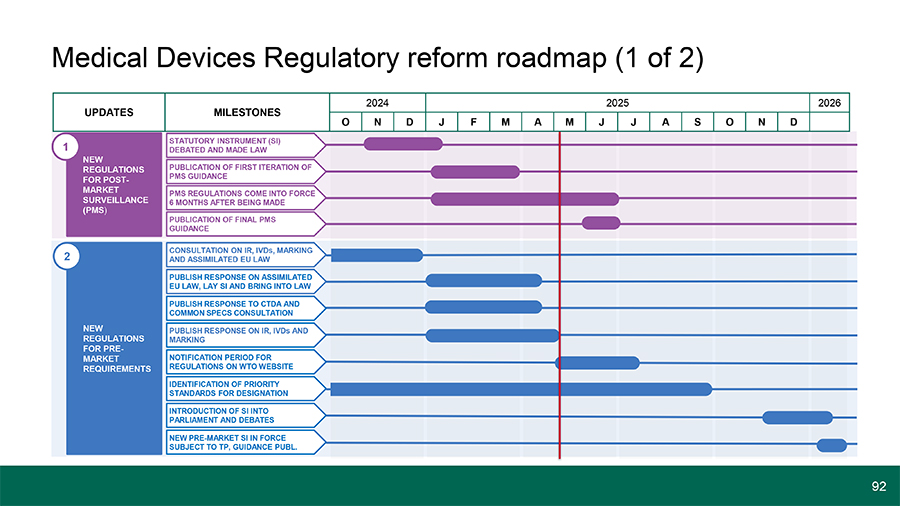

Rob emphasised the critical role of PMS in ensuring safety and enabling faster, yet responsible, market access.
Historically, PMS requirements under UK MDR were set out in guidance rather than legislation, resulting in inconsistent compliance. “We had some companies that were doing a very good job… and others that weren’t,” Rob stated. By introducing PMS into legislation, the MHRA aims to level the playing field and ensure higher safety and performance standards.
The new PMS regulations will apply to all medical devices placed on the market or put into service in Great Britain from 16 June 2025. This includes devices approved via CE marking or the Northern Ireland Protocol, although there are limited exemptions (e.g. for custom-made devices and those used in clinical investigations).
Key features include:
Manufacturers must implement a PMS system based on a detailed PMS plan, covering incident reporting, feedback collection, and corrective actions. As Rob noted: “It’s not just safety that matters… post-market surveillance provides the opportunity to monitor performance in the real world.”
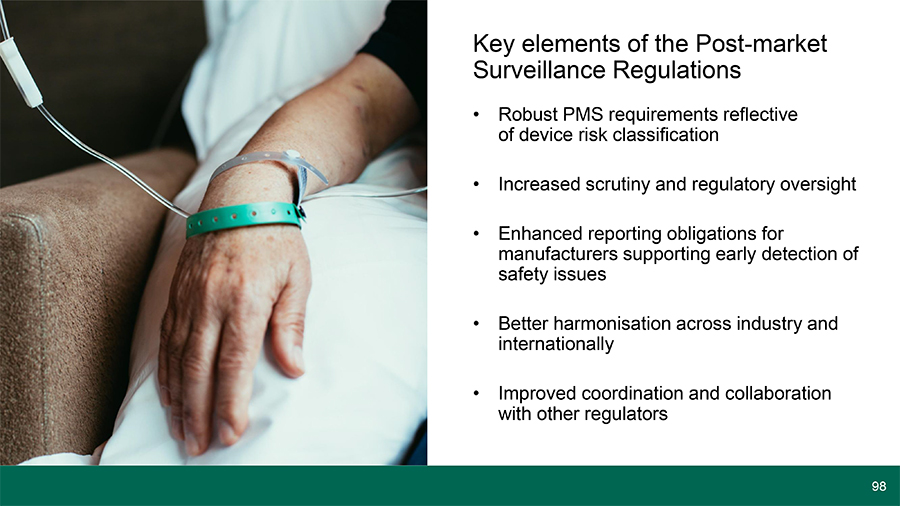
The second priority area is the forthcoming premarket regulations, which are currently being finalised following consultation. These will focus on essential changes, including:
This last point marks a significant shift. The UK will begin recognising approvals from trusted regulators such as Australia, Canada, the EU, and the US, with implementation of international reliance pathways expected from mid-2027. Rob explained: “This will effectively be the long-term response or solution in terms of international reliance.”
These regulatory updates are expected to be laid in Parliament by the end of 2025, subject to legislative scheduling, with some measures entering force by mid-2026.


The MHRA recognises that regulation must evolve alongside rapid technological advancements. For areas like AI and software, the agency is prioritising agile, guidance-led approaches rather than rigid legislation. Rob highlighted the UK’s international leadership in this area and initiatives like the AI Airlock, a regulatory sandbox designed to help innovators navigate approval pathways.
Additional future enhancements under consideration include policies for early access to devices, sustainability, remanufacturing, and health institution exemptions. The MHRA is also developing a fee-based scientific and regulatory advice service for companies with complex regulatory challenges.
BHTA members and the wider medtech community were encouraged to engage with the new PMS guidance, prepare for compliance, and stay informed as the MHRA rolls out the next stages of medical device regulatory reform.
The Medicines and Healthcare products Regulatory Agency (MHRA) published a statement of policy intent for international recognition of medical devices on 21 May 2024.
Entitled ‘Statement of policy intent: international recognition of medical devices’, it describes how the UK Government intends to recognise regulatory approvals from Australia, Canada, the European Union, and the United States of America depending on device type, class, and prior approval.
The MHRA continues to review the list of comparable regulator countries and is in active discussions with the Pharmaceuticals and Medical Devices Agency (PMDA) to explore the recognition of medical device approvals from Japan.
The MHRA’s statement of policy intent focuses on ensuring safe access to quality-assured medical devices and reducing the duplication of assessments by comparable regulators to enable resource to be focused on more innovative products for the benefit of patient health. This statement will also allow manufacturers to start considering whether their devices will be eligible for the proposed alternative routes to market.
The proposed framework is still in draft, and the final version would be integral with the future core regulations.
Dr Laura Squire, Chief Quality and Access Officer of the MHRA, said: “Today’s announcement is an important step forward towards a robust MedTech regulatory framework that prioritises patient safety, gives patients access to the medical devices they need and ensures the UK remains an attractive market for medical technology innovators.
“We will continue to work on how our intended policy on international recognition of medical devices will operate in practice. By sharing the draft policy now, we aim to give greater clarity about the MHRA’s future direction of making regulatory approvals simpler, where it is safe to do so. At the same time, we remain fully committed to the UKCA marking for medical devices.
“We continue to expand capacity in UK Approved Bodies and to work to ensure UKCA marking supports safe and earlier access to the most innovative and transformative medical products.”
To be eligible for the proposed framework, medical devices will need to:
The proposed framework would provide a certificate of international recognition that will grant devices access to the Great Britain market but would not provide a UKCA marking or UKCA certification. MHRA underlines that manufacturers of medical devices would still have the option to use the UKCA marking to place devices on the Great Britain market.

The Medicines and Healthcare products Regulatory Agency (MHRA) has designated two new UK Approved Bodies, delivering increased capacity for the certification of the performance and safety of medical devices.
LNE-GMED UK and Scarlet NB UK join the seven current UK Approved Bodies, increasing capacity for the certification of medical devices in the UK.
LNE-GMED UK has been designated as a UK Approved Body to assess and certify general medical devices in accordance with Part II of the UK Medical Devices Regulations 2002. Scarlet NB UK has been designated with a focus on assessing and certifying software and AI as a medical device (AI/SaMD).
This comes after two of the existing UK Approved Bodies had their scope expanded, with UL International UK now designated to assess and certify general medical devices (in addition to in-vitro devices), and TÜV SÜD now designated to assess and certify active implantables (in addition to general medical devices).
Before appointing an Approved Body, the MHRA conducts a detailed assessment process to ensure that organisations are stable and able to undertake impartial and objective conformity assessment activities; have an appropriate quality management system; and have the capacity and competence to undertake assessments and the processes they use meet the relevant regulatory requirements.
After successful designation, the MHRA monitors UK approved bodies’ activities including by regular audits and by witnessing some of their audits of manufacturers.