
- Back
- Back
- Back
- Back
- Back
- Back
- Back
- Back
- Back
- Back

The UK Government has tabled three amendments to the Health Bill that could help shape the future regulation of medicines and medical devices in the UK.
The Medicines and Healthcare products Regulatory Agency (MHRA) has recently announced the proposals, which cover amended information-sharing powers, measures to make medicines and medical devices legislation easier to update, and enabling powers to support a future medical device licensing regime.
There are no immediate changes to medical device regulatory requirements as a result of the proposals.
The first amendment would give the MHRA clearer legal powers to share specific information about medicines and medical devices with trusted UK government organisations and global regulatory partners.
The MHRA says the changes would support public health, patient safety, access to innovation, and effective regulation.
Safeguards would remain in place, including statutory criteria governing when information can be shared and requirements to ensure that sharing is necessary and proportionate. Commercially sensitive information and patient data would continue to be protected.
The second amendment is intended to make medicines and medical devices legislation easier to update as science and technology develop.
It would allow legislation to automatically reflect future updates to certain documents, including technical standards and international guidelines. The intention is to help the regulatory framework keep pace with scientific and technological developments without requiring legislation to be amended each time relevant documents are updated.
The proposals would also enable a more proportionate approach to consultation. Technical, administrative, or minor regulatory changes could be subject to more targeted consultation, while significant policy changes would continue to involve full public consultation.
The government is also proposing changes to how some regulatory updates are handled by Parliament. Technical, administrative, or minor regulatory changes could become law unless Parliament objects.
Potentially the most significant proposal for medical device businesses is the creation of enabling powers to support a future medical device licensing regime.
The amendment would make changes to the Medicines and Medical Devices Act 2021, providing the legal foundation for a future framework.
Under the approach being explored, medical devices placed on the Great Britain market through a domestic route could in future require a licence issued by the MHRA, rather than relying on third-party conformity assessments.
The enabling powers would not themselves introduce a medical device licensing regime. The detailed design of any future framework, and how it would interact with the existing regulatory system, would be developed with stakeholders.
The MHRA says any future system would take a risk-proportionate approach, and would be subject to further policy development, public consultation, impact assessment, and parliamentary scrutiny. The aim is to support a modern and adaptable framework capable of responding to emerging technologies, including software and AI-enabled medical devices.
The UKCA regime will remain in place in Great Britain while any future model is developed, and the MHRA says its intentions concerning international reliance and recognition remain unchanged.
Northern Ireland will continue to apply the EU Medical Device and In Vitro Diagnostic Regulations under the Windsor Framework.
The MHRA’s proposals have been tabled as amendments to the Health Bill, which already contains measures relating to medicines and medical device regulation.
The current version of the Bill includes provisions concerning technical standards, international regulatory requirements, consultation, and parliamentary procedure. The three newly tabled amendments would add to and develop these existing regulatory reforms and are not reflected in the current published version of the Bill.
The amendments will now be considered as the Health Bill continues its passage through Parliament. Where further measures are required, these would be subject to additional development and consultation before being implemented.
The BHTA will continue to monitor developments and keep members informed as further details emerge.
The Medicines and Healthcare products Regulatory Agency (MHRA) has outlined the next stage of its medical devices regulatory reform programme, providing further details of its proposed Pre-market Statutory Instrument (SI) during a joint BHTA and AXREM webinar.
Speaking during the webinar, Dr Rob Reid, Deputy Director for Innovative Devices at the MHRA, explained how the proposed legislation aims to modernise the UK Medical Devices Regulations 2002 while balancing patient safety, innovation, and timely access to medical technologies.
The proposed reforms are designed to support safe and rapid access to medical devices through risk-proportionate and predictable routes to market, new International Reliance pathways, a UKCA framework focused on innovation, and closer alignment with international standards to support harmonisation and collaboration.
BHTA members who were unable to attend can watch the recording of the MHRA Pre-market Statutory Instrument webinar.
Dr Reid said reform is needed to respond to rapid technological advances, address recommendations from the Independent Medicines and Medical Devices Safety Review, and align the UK regulatory framework more closely with international best practice. These priorities also support the ambitions set out in the UK Government’s Life Sciences Sector Plan and the 10 Year Health Plan for England, both of which recognise the important role medical technology plays in improving patient outcomes and driving economic growth.
The Pre-market SI is one part of a broader programme of regulatory reform. It follows the introduction of strengthened post-market surveillance requirements, while further policy work is already underway on areas such as electronic labelling, clinical investigations, health institution exemptions, and the future regulation of software and artificial intelligence (AI).
Rather than replacing the UK MDR 2002, the draft SI makes targeted amendments to the existing regulations while leaving other areas unchanged.
The draft SI would introduce:
See the slide below for the draft future UK MDR 2002 structure:
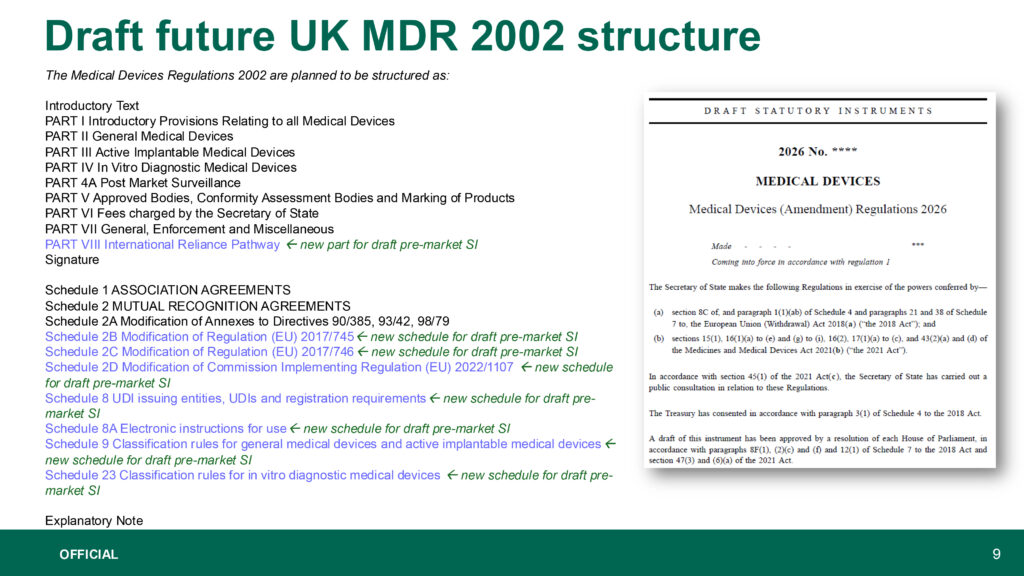
However, Dr Reid emphasised that several parts of the regulations are not being amended through the current legislation. Clinical investigations, performance evaluations, health institution exemptions, Approved Body designation and oversight, certain conformity assessment procedures, systems and procedure packs, exceptional use provisions, and market surveillance powers will instead be considered as part of future phases of the MHRA’s wider reform programme.
The draft SI would also update key definitions relating to medical devices, implantable devices, and intended purpose, bringing them more closely into line with international approaches. The UK’s Essential Requirements governing safety, performance, and labelling would also be revised to align more closely with the EU’s General Safety and Performance Requirements (GSPRs), with modifications for the Great Britain regulatory framework. The MHRA intends to publish guidance and implementation checklists to support manufacturers.
The draft SI would strengthen technical documentation requirements, requiring manufacturers to maintain up-to-date, searchable technical documentation in English and make it available to the MHRA within three working days if requested, with flexibility for extensions where appropriate. Document retention periods would also increase to the longer of the device’s lifetime or 15 years for implantable devices, and the longer of the device’s lifetime or 10 years for non-implantable devices. These changes are intended to improve regulatory oversight and support more effective post-market surveillance.
The proposals would also strengthen traceability through mandatory Unique Device Identifiers (UDIs) and new implant card requirements. Manufacturers would provide implant cards and patient information leaflets, while healthcare providers would record device identifiers to support incident reporting, recalls, and long-term traceability.
Recognising the increasing role of software in healthcare, the draft SI also introduces Pre-Determined Change Control Plans (PCCPs), allowing certain pre-approved software updates without requiring a new conformity assessment, provided they remain within agreed parameters. New cybersecurity requirements would align more closely with international best practice by requiring manufacturers to minimise cybersecurity risks and provide appropriate information for users. Dr Reid confirmed that proposed changes to software classification have been deliberately deferred while the MHRA considers recommendations from the National Commission on the Regulation of AI in Healthcare.
The proposals would also expand the circumstances in which electronic instructions for use (eIFUs) may be used for certain devices, subject to appropriate risk assessments. Paper instructions would still be required where information is intended for patients.
The draft SI also updates requirements for custom-made devices, introducing stronger quality management and traceability measures for certain higher-risk implantable devices.
A key proposal is the introduction of International Reliance pathways, allowing the MHRA to make greater use of approvals granted by trusted regulators in the United States, Canada, and Australia. Rather than duplicating existing regulatory assessments, the new approach is intended to provide a more proportionate route to the Great Britain market while maintaining appropriate safeguards for patient safety.
Dr Reid explained why the European Union is not included within the proposed International Reliance routes. Following consultation with industry, the MHRA concluded that requiring Approved Body involvement for CE-marked devices could create additional barriers to market. Instead, the UK Government is considering the future recognition of CE marking separately, with a response to the consultation expected in due course.
The draft SI also introduces new provisions governing promotional claims and equivalence. Promotional material would be expected to be evidence-based, consistent with the device’s intended purpose and instructions for use, communicate relevant risks appropriately, and avoid misleading users. Manufacturers relying on equivalence would also be required to provide stronger technical, biological, and clinical justification to support their claims.
The draft Pre-market SI has now completed its 60-day notification period through the World Trade Organization (WTO). The MHRA is reviewing comments received during that process before finalising the legislation for introduction to Parliament later this year.
BHTA members can review the draft Pre-market Statutory Instrument on the WTO website.
Subject to parliamentary approval, the new regulations are expected to come into force around the middle of 2027. Alongside the legislation, the MHRA intends to publish detailed guidance and implementation materials to support manufacturers as they prepare for the changes.
The BHTA will continue to keep members informed as the legislation progresses and further MHRA guidance becomes available. BHTA members can access both the webinar recording and draft SI for further detail.