
- Back
- Back
- Back
- Back
- Back
- Back
- Back
- Back
- Back
- Back
The latest NHS Supply Chain (NHSSC) supplier webinar, held on 3 December 2025, provided essential updates for suppliers on cybersecurity compliance and sustainability expectations. The session, part of NHSSC’s regular information series, featured speakers from its Cyber Security and Sustainability teams, offering insight into upcoming requirements that suppliers will need to meet to remain eligible for tenders and contracts.
Jennie Lewis, Cyber Security Compliance Coordinator at NHS Supply Chain, led the session’s opening presentation on supplier cybersecurity. She outlined NHSSC’s adoption of the UK Government’s Procurement Policy Note (PPN) 014, which sets out new baseline security expectations for all suppliers in scope.
All suppliers handling personal information or providing ICT systems and services will be required to demonstrate compliance with Cyber Essentials Plus — a government-backed certification that confirms an organisation has robust cybersecurity controls in place. Certificates must be renewed annually and verified through an external audit. Suppliers can confirm certification validity via IASME, the national accreditation body.
Suppliers processing NHS patient data will also need to complete the Data Security and Protection Toolkit (DSPT), an NHS England-mandated self-assessment to evidence responsible data handling and compliance with information governance standards. For questions on data or security requirements, suppliers can contact cybersecurity@supplychain.nhs.uk.
Where suppliers do not yet hold Cyber Essentials Plus or DSPT certification, NHS Supply Chain has introduced an Information Security Third Party Questionnaire (ISTPQ). This pass/fail assessment, completed at the Supplier Questionnaire stage of a tender, will be reviewed by NHSSC’s Cyber Security Team to assess equivalency to Cyber Essentials standards. NHSSC will take a risk-based approach to non-compliance, weighing the criticality of the product or service against potential cyber risk. However, suppliers without certification may face reduced opportunities for participation in future tenders.
The Cyber Security Team also confirmed that NHS England will be notified of any vulnerable or insecure products or services identified through this process, as part of broader efforts to strengthen supply chain resilience across the NHS.
The second presentation, delivered by Jade Gaffney, Sustainability Advisor, and Heidi Barnard, Head of Sustainability, explored the Evergreen Sustainable Supplier Assessment, one of five key sustainability criteria suppliers must meet. The “Five Asks” — covering Carbon Reduction Plans, Social Value, the Evergreen Assessment, Horizon Scanning, and Modern Slavery — are central to NHS England’s net zero and sustainability strategy.
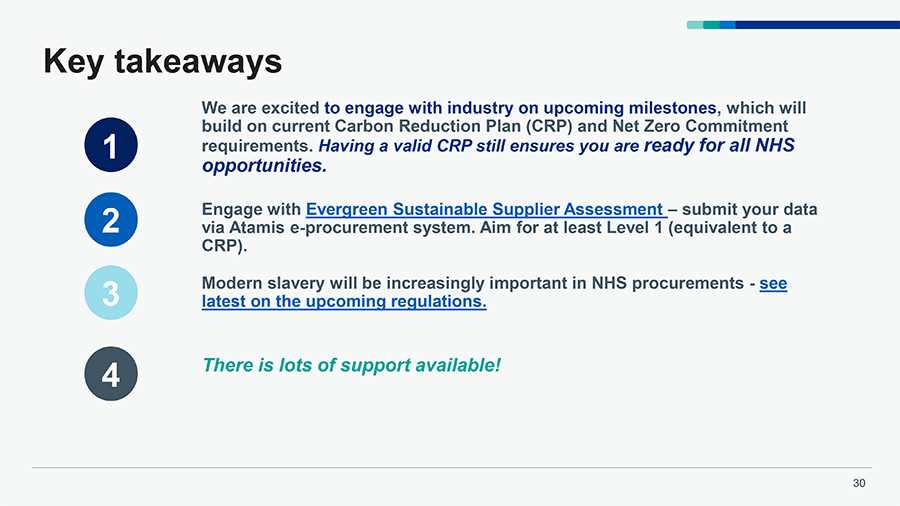
From 1 April 2026, all suppliers bidding for new NHSSC tenders will be required to achieve Evergreen Level 1 or above. Level 1 aligns with the Carbon Reduction Plan requirements, meaning suppliers must publicly commit to achieving net zero carbon emissions by 2050 for all scopes. Suppliers unable to meet this requirement will remain eligible for existing contracts but may be excluded from new tenders after this date.
The Evergreen Assessment is hosted on the Atamis platform, accessible under the Information section. NHSSC advised suppliers to ensure their Evergreen submission is correctly linked to their Atamis account to prevent data visibility issues. Annual updates are mandatory, with no automatic reminders issued. Suppliers gathering Scope 3 emissions data should enter “0” placeholders where figures are unavailable, ensuring the assessment remains complete. Queries about sustainability assessments can be directed to sustainability@supplychain.nhs.uk.
The Evergreen framework supports NHSSC’s goal of embedding environmental accountability throughout its supply base, ensuring that procurement decisions contribute directly to the NHS’s wider sustainability and net zero commitments.
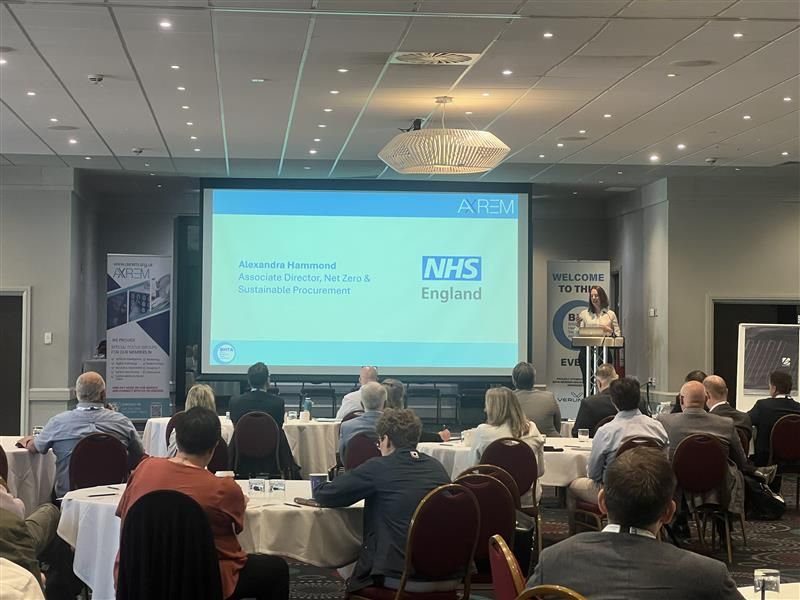
At ‘The Future of MedTech – Innovating for Tomorrow’ conference, Alexandra Hammond, Associate Director for Net Zero & Sustainable Procurement at NHS England, delivered the second part of a talk titled ‘Building a Sustainable Future through Responsible Procurement’.
Hosted by the British Healthcare Trades Association (BHTA) and AXREM, the conference took place on 13 May 2025 at The Mercure, Northampton.
The first part of the talk was delivered by Chris Taylor, Sustainability Lead UKI at Philips Health Systems.
Alexandra provided an in-depth look at how NHS England is embedding sustainability, social value, and modern slavery prevention into its procurement practices, all in support of the NHS’ broader net zero ambitions.
Alexandra began by highlighting that 66 percent of the NHS’ carbon footprint lies within its supply chain, positioning sustainable procurement as a powerful tool in the journey towards net zero. Her team’s mandate focuses on sustainable procurement and supply chains, while also driving social value and tackling modern slavery.
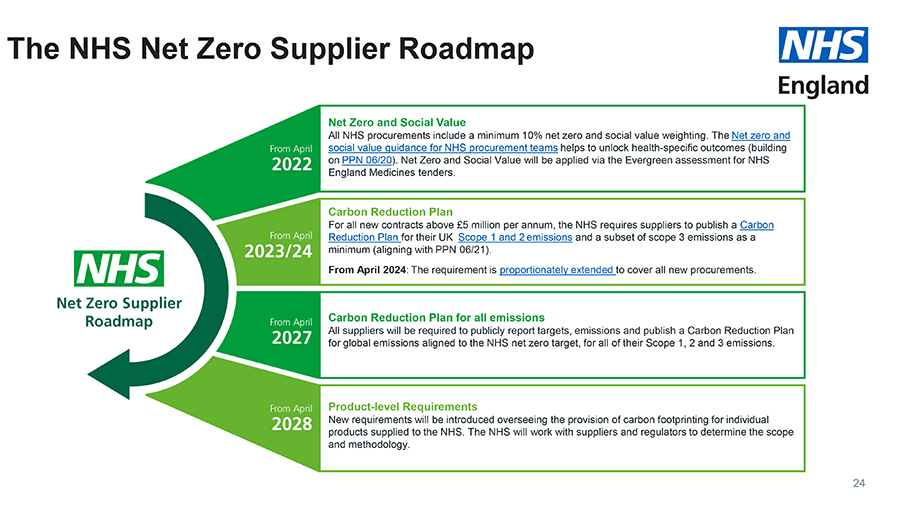
She reminded attendees of the NHS’ clear commitment: by the end of this decade, it will no longer work with suppliers who are not aligned with its net zero goals. To support this, the NHS Net Zero Supplier Roadmap lays out a series of milestones, several of which are already in place. These include embedding social value in all procurements and requiring suppliers to provide a carbon reduction plan.
From 2027, suppliers will be expected to expand the scope of their carbon reporting, with additional requirements on product-level emissions and disclosure coming in 2028. Alexandra emphasised that these future milestones are still in development and urged suppliers to take part in shaping the final policies.
A key enabler of the NHS’ sustainability work, Alexandra noted, is the National Procurement Policy Statement, published on 13 February 2025. This policy reinforces NHS England’s commitment to embedding net zero, social value, and ethical standards in procurement. Importantly, it aligns with wider government priorities for the public sector, including building an NHS for the future, kickstarting economic growth, and making the UK a clean energy superpower.
Alexandra explained that the statement is more than just guidance – it provides a formal basis for public sector organisations, including NHS bodies, to adopt procurement practices that reflect environmental and social priorities. It marks a shift from policy aspiration to concrete expectation.
Alexandra reassured suppliers that NHS England will take a proportionate, clear, and collaborative approach, with plenty of notice before implementing new policies. She noted that NHS England is listening closely to supplier feedback.
She also pointed to the NHS Evergreen Sustainable Supplier Assessment, hosted within the NHS Atamis e-procurement system, as a key tool for dialogue between the NHS and suppliers on sustainability. This tiered assessment enables suppliers to track and improve their maturity level on sustainability issues, without duplicating information across multiple systems.
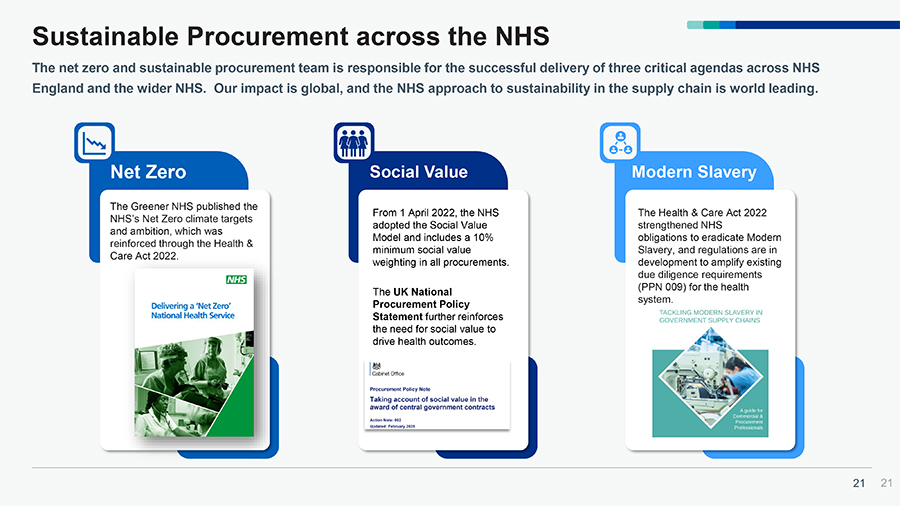
Beyond net zero, Alexandra spoke about the evolving expectations around social value. The government’s updated procurement priorities now include building a future-ready NHS, alongside themes such as clean energy, economic growth, and inclusion.
New regulations on modern slavery are also on the horizon, with NHS England working closely with the Department of Health and Social Care to ensure that supply chains are fair, ethical, and transparent. Procurement will play a central role in embedding these requirements across the health system.
For BHTA members, Alexandra’s message was one of opportunity and urgency. The NHS is committed to supporting suppliers, including SMEs, with tools, guidance, and access to events and on-demand resources such as emissions verification webinars and updates on science-based targets.
Alexandra concluded with a strong call to action for suppliers: engage with the NHS on these changes, make use of the Evergreen tool, and help co-design the future of sustainable procurement.

Insights from ‘Building a Sustainable Future through Responsible Procurement’ by Chris Taylor, Sustainability Lead UKI at Philips Health Systems
At ‘The Future of MedTech – Innovating for Tomorrow’, a joint conference hosted by the BHTA and AXREM on 13 May 2025 at The Mercure, Northampton, Chris Taylor, Sustainability Lead UKI at Philips Health Systems, delivered the first part of a compelling talk titled ‘Building a Sustainable Future through Responsible Procurement’.
His message to suppliers in the healthcare and medtech sector was clear: the journey to NHS net zero cannot be travelled alone, and suppliers play a critical role.
Chris began by setting the scene. As a planet, we are consuming resources at an unsustainable rate: 1.7 earths’ worth annually and climbing. Healthcare contributes significantly to environmental pressures through emissions, waste, and material use. The NHS, for instance, emits 125kg of CO₂ per hospital bed per day. Chris highlighted the growing evidence linking climate change with human health outcomes, calling on suppliers to act in unison to help tackle this challenge.
With 71 percent of the NHS’ emissions falling under scope 3 – those generated across its supply chain – Chris emphasised that suppliers are central to achieving the NHS’ net zero ambitions.
To support this, Philips partnered with the University of Exeter to produce a report, which highlights how suppliers can reduce material consumption and embed sustainable practices. The report breaks down actions into three areas: understanding the challenge, setting clear targets, and making tangible changes.
Key takeaways for suppliers:
In closing, Chris encouraged BHTA and AXREM members to see sustainability not as a compliance burden, but as an innovation opportunity. By aligning with the NHS net zero roadmap and embracing circular economy principles, suppliers can lead the way in building a healthier, more resilient future for both people and the planet.


