- Back
- Back
- Back
- Back
- Back
- Back
- Back
- Back
- Back
- Back

The latest NHS Supply Chain (NHSSC) supplier webinar, held on 1 July 2026, provided further detail on the future Single Transacted National Price (STNP) programme, alongside updates on value-based procurement (VBP), clinical evidence requirements, and sustainability.
The webinar also reinforced expectations around value-based procurement and robust clinical evidence to support procurement decisions.
NHSSC provided further detail on its STNP programme, which forms part of the Commercial Transformation Programme’s Pricing Simplification project and will be introduced progressively as part of NHS Supply Chain 2030.
The proposed model will see all transacted frameworks move towards a single national buy price for each product, supported by new national value mechanisms designed to aggregate commitments across the NHS and maximise value. Centrally funded customers would access the same national sell price, removing customer-specific pricing tiers, banding, and additional discounts, while price variation would remain only for non-centrally funded customers where centrally determined margins apply.
Suppliers would be expected to support the transition by moving away from negotiating customer-specific discounts and rebates for NHS Supply Chain sales. Incentive schemes would instead be managed centrally, while frameworks unable to support STNP may, by exception, transition to a non-transacted (direct) procurement route.
NHSSC said pricing simplification aims to improve transparency, reduce administrative complexity, and create a more predictable pricing environment, allowing both suppliers and NHSSC to focus more on innovation, product development, and delivering value to the NHS.
Implementation will be gradual. In the short term, the National Value Programme will continue to optimise existing National Pricing Matrices (NPMs), including removing some where appropriate. Over time, new pricing mechanisms will replace NPMs and Market Basket Management Strategies (MBMS) as frameworks are renewed, enabling full adoption of STNP. NHSSC also confirmed it does not intend to return to commitment discounts or direct rebates as part of the new approach.
Value-based procurement (VBP) remains a key focus for NHSSC. As outlined in BHTA’s previous article on the new NHS value-based procurement guidance, suppliers are increasingly expected to demonstrate value across six domains: social value, efficiency, patient and staff outcomes, supply chain resilience, purpose, and whole-life cost.
The webinar highlighted a significant change in how supplier responses are evaluated. Rather than relying on pass/fail or yes/no assessments, procurement exercises will increasingly use scored, text-based responses to assess the strength of each submission. Meeting the minimum requirement is now considered the starting point, with suppliers expected to explain and evidence how their solution delivers greater quality and value than competing offers.
NHSSC also confirmed that VBP extends beyond contract award. Commitments made during the procurement process become part of the long-term offer, with value monitored and measured throughout the life of the contract. The same value criteria may also be applied during call-off competitions and further competitions under framework agreements.
NHSSC reiterated that clinical evidence plays a vital role in supporting product assessments and NHS procurement decisions.
Suppliers were reminded that evidence should, wherever possible, be published in peer-reviewed journals. Where evidence is based on case studies or case reports, NHSSC said research from the UK or comparable healthcare systems, including France, Denmark, Canada, and Australia, is particularly valuable. Larger international studies can also strengthen submissions where they have been published internationally or presented at recognised conferences.
NHSSC also highlighted guidance from the National Institute for Health and Care Excellence (NICE), which states that clinical evidence should be relevant to the evaluation, transparently reported, systematically assembled, and analysed using robust methods that minimise bias. NICE also recommends clearly justifying the selection of outcomes, resource use, and costs within the evidence base.
Suppliers were encouraged to focus evidence on the specific product being submitted, move beyond marketing claims, clearly explain the problem the product is intended to solve, and use evidence relating to the current product rather than previous generations. NHSSC also advised against relying on generic therapy-area evidence or evidence from unrelated products to support claims.
The webinar concluded with a brief update on sustainability requirements.
NHSSC confirmed it is reviewing NHS England’s updated 2027 Net Zero supplier requirements to determine how they will be implemented operationally. No further detail was provided, although suppliers were advised that further updates will follow as this work progresses.
NHS Supply Chain’s March 2026 supplier webinar included a number of updates for suppliers, but two are particularly important for BHTA members: changes to the Economic and Financial Standing (EFS) guidance note, and clarification around distributor and subcontractor arrangements.
On EFS, NHS Supply Chain said the government guidance note on Economic and Financial Standing was updated on 31 December 2025, with NHSSC revising its own approach in response. NHSSC said the underlying methodology was first introduced through Procurement Policy Note guidance in 2023, later embedded into the Procurement Act 2023, and has been reflected in its Invitation to Tender documentation since spring 2024.
NHSSC said it uses EFS to assess suppliers’ overall risk rating by testing and scoring five key financial ratios alongside a Dun & Bradstreet Failure Score, using the bronze scale. It said this is not a pass/fail measure for general award, but a contract management and risk tool. However, NHSSC noted that a supplier rated High, its highest level of concern, could still be excluded from mini competitions held after a general award.
NHSSC also said customers can ask to see a supplier’s EFS rating as part of their due diligence. Suppliers that are concerned about receiving a low score, or know they typically score red against some financial characteristics, can speak to NHSSC in advance through their Category Manager, provided this happens before they are in tender.
The main change is that the updated guidance now explicitly applies to framework-based awards. NHSSC said it will continue using the same tests as before, but with updated parameters, and the new ratios are set out in the revised guidance note. Suppliers can compare the old and new versions side by side to understand what has changed.
NHSSC said it will not amend its documentation or testing before 1 April 2026. It described the revised thresholds as generally tighter for the strongest ratings, while also saying that the changes appear limited in practice. Based on a broad sample of more than 500 current suppliers, fewer than 20 saw a change in their overall rating, with as many ratings improving as worsening.
The webinar also included an early heads-up on NHSSC’s compliance work around distributor and subcontractor arrangements within tenders. In simple terms, NHSSC should only pay invoices issued by an awarded supplier.
Where a distributor supports the party that has tendered for and secured a place on a framework, NHSSC said that distributor is effectively acting as a subcontractor. According to the example shared in the webinar, this arrangement is compliant provided the distributor has an agreement with the manufacturer that remains valid for the duration of the framework.
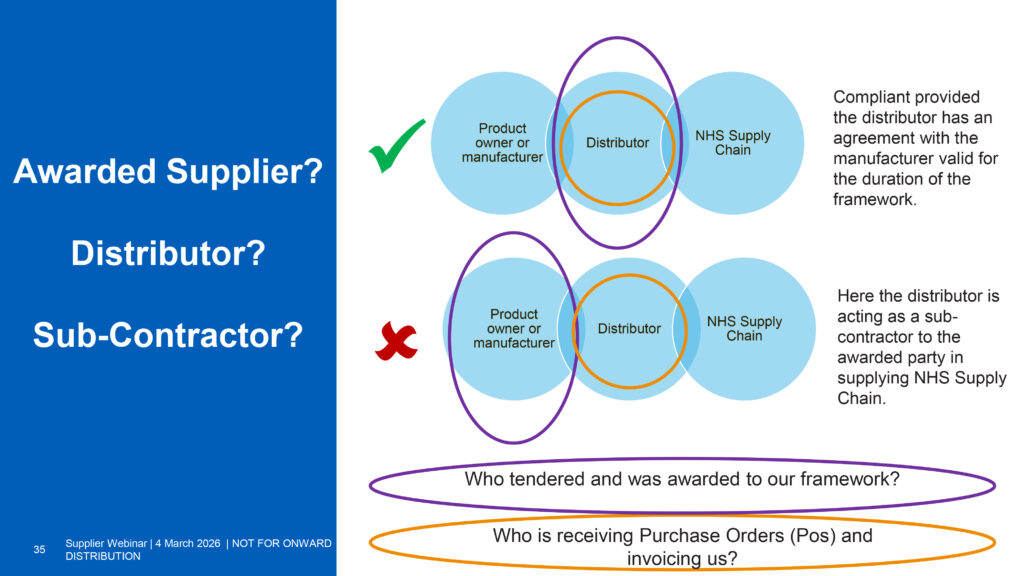
NHSSC indicated that this work is still under review and said any companies affected would be contacted individually. For BHTA members, the message is less about an immediate rule change and more about making sure contractual relationships, invoicing arrangements and framework responsibilities are aligned with the awarded supplier model.
Other webinar topics included the renaming of the Innovation Team to the Health Innovation Team Members also heard about NHSSC’s inbound logistics service, which provides end-to-end collection and delivery through a nationwide network used by more than 120 suppliers. The webinar also highlighted free support available through The King’s Trust, formerly The Prince’s Trust, which can help companies in high-need areas recruit young people into roles that support the health and social care sector, as part of its wider work to improve opportunities for young people in disadvantaged communities.