
- Back
- Back
- Back
- Back
- Back
- Back
- Back
- Back
- Back
- Back
The NHS is strengthening its commitment to innovation and efficiency through the introduction of new value-based procurement (VBP) standards for medical technology.
The Department of Health and Social Care (DHSC) has published the ‘Value Based Procurement Standard Guidance for Medical Technology’, designed for use within the NHS’s 13 VBP pilots. Although the guidance has been created to support these pilot projects, it also provides valuable insights and practical applications for the wider medical technology sector.
The guidance is intended for use by both NHS buyers and suppliers to help assess not only the cost of medical devices but also the broader value they deliver to patients, staff, and the healthcare system.
This shift towards value-based decision-making comes alongside the government’s announcement that the NHS will invest in pioneering technology to help reduce waiting lists and improve productivity across services. Together, these initiatives aim to ensure that procurement decisions increasingly reward technologies that demonstrate measurable improvements in outcomes, efficiency, and sustainability.
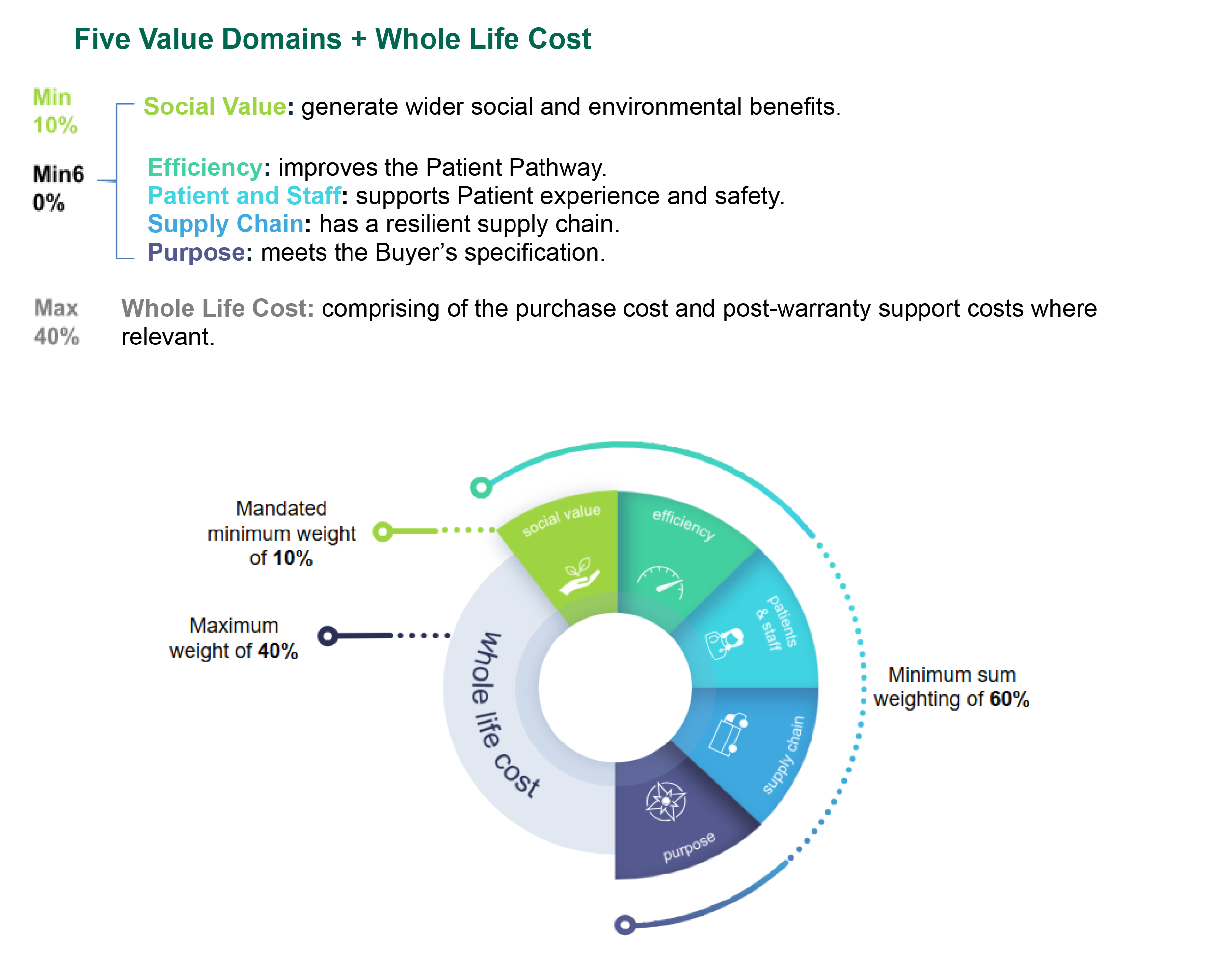
The new DHSC guidance establishes a framework for evaluating medical devices across five domains: social value, efficiency, patient and staff outcomes, supply chain resilience, and purpose. A sixth factor, whole-life cost, complements these domains by ensuring that price is considered within the broader context of lifecycle value.
Under the new framework, NHS buyers are encouraged to assess tenders not solely on upfront cost but on the overall contribution a product or service makes to the health system.
Each domain can be weighted according to the needs of a particular procurement, but social value must account for at least 10 percent of the total weighting, in line with the NHS Social Value Playbook. Overall, at least 60 percent of procurement scoring must relate to the value domains, while whole-life cost is capped at 40 percent.
This marks a step away from purely price-driven procurement and towards a model that prioritises long-term outcomes, sustainability, and patient benefit.
Each of the five value domains provides a structured set of questions and evaluation criteria for buyers and suppliers. The social value domain encourages suppliers to demonstrate how they will reduce carbon emissions, manage modern slavery risks, or improve sustainability in packaging and disposal. The efficiency domain considers how a product can simplify patient pathways, increase hospital or community productivity, and support accurate measurement of outcomes. The patient and staff domain emphasises safety, patient experience, and health equity, while supply chain and purpose focus on resilience, interoperability, and ease of use.
Suppliers are expected to provide measurable, evidence-based responses that show how their technologies can deliver tangible improvements. This includes providing baseline data, real-world evidence, and models that quantify benefits such as reduced complications, improved patient satisfaction, or optimised workforce time.
The guidance is part of a wider shift within the NHS towards integrating innovation, sustainability, and productivity.
Andrew New, CEO of NHS Supply Chain, said: “Innovative technology has a vital role to play in delivering faster, simpler and more effective care for patients. Through this new approach, we can ensure that procurement not only secures the best value for money but also supports the NHS in achieving its long-term goals around efficiency, sustainability and patient outcomes.”
BHTA member companies supplying medical technology to the NHS will need to engage more deeply with buyers to demonstrate measurable value through data, evidence, and partnership. This includes clearly articulating how their products support clinical efficiency, improve patient experience, and align with NHS sustainability objectives.
The framework also highlights the importance of collaboration between suppliers, clinical teams, and procurement professionals. Bidders are encouraged to provide evidence that supports their claims, including quantitative data, modelling, and independent validation where possible.
The guidance advises buyers to ensure proportionality in their tender requirements to support the participation of small and medium-sized enterprises (SMEs) within the medtech sector.
Suppliers may wish to focus on areas such as:
By preparing evidence-rich submissions aligned to the five value domains, suppliers can better position themselves to succeed in NHS tenders under this new approach.
The VBP guidance underscores a wider movement within the healthcare system towards smarter, more sustainable procurement. As the NHS aims to make better use of technology to enhance care delivery, these frameworks are helping to ensure that procurement decisions reflect genuine long-term value.
Andrew added: “By focusing on value rather than volume, we are creating the conditions for innovation to thrive — enabling suppliers to bring forward solutions that improve outcomes for patients and deliver efficiencies for the NHS.”

NHS England has released its ‘NHS Social Value Playbook’, a practical 46‑page guide that shows commissioning and procurement teams – and the businesses that serve them – how to place social, economic, and environmental value at the heart of every contract.
Published on 14 July 2025, the document translates policy into step‑by‑step actions across the buying lifecycle, from early planning to post‑award performance management.
Since 2020, all NHS contracts above £5 million have carried a minimum mandatory 10 percent net zero and social value weighting.
Feedback gathered by NHS England, however, revealed that many purchasing teams still felt uncertain about designing meaningful questions, evaluating responses, and measuring delivery, while suppliers wanted clearer, more consistent expectations around social value.
The new playbook responds to both groups by providing usable text, worked examples, and links to templates.
The guidance discusses each stage of the commissioning or procurement journey. It begins with business‑case development, urging buyers to identify which of the government’s eight social value themes – for instance “Fighting Climate Change” and “Tackling Inequality” – can best advance local and national health priorities. It then recommends collaborative pre‑market engagement so suppliers can help refine the brief and flag disproportionate requirements.
For the tender itself, the document supplies example questions and scoring matrices that reflect suppliers’ different sizes and capabilities. Importantly, it allows commissioners to elevate a theme, such as modern slavery prevention, from “added value” to a core contract requirement when risks or opportunities justify the move. This flexibility, the playbook states, is central to making social value business as usual rather than an afterthought.
The final chapters focus on contract management. They show how to set specific, measurable, achievable, relevant, and time‑bound key performance indicators, linking them to payment milestones and improvement plans. An annex lists ready‑made metrics – for example tonnes of carbon avoided or number of apprenticeships created – that buyers can lift directly into their agreements, as an example.
“Applying social value provides NHS commissioning and buying teams the unique opportunity to improve patients’ lives and the communities they live in through how we buy and the way we manage contracts,” the guide notes, adding that it can drive the supply chain “to deliver additional social, economic and environmental benefits alongside their commercial commitments.”
The playbook aligns with the 2025 refresh of the UK Government’s Social Value Model and supports the NHS 10‑Year Health Plan’s commitments on sustainability and health inequality.
For companies selling to the NHS – including BHTA members – the document spells out the evidence buyers will look for, stresses that proportionality matters when smaller firms compete, and warns that carbon reduction plans and anti‑modern‑slavery measures may be mandatory rather than nice to have.
Suppliers that embed social value into product design, service delivery, and reporting will therefore be better placed to demonstrate compliance and stand out in future tenders.