
- Back
- Back
- Back
- Back
- Back
- Back
- Back
- Back
- Back
- Back

NHS Supply Chain (NHSSC) has provided suppliers with updates on its Commercial Transformation Programme, cyber security requirements, and approach to social value as part of its latest supplier webinar.
The webinar outlined plans for earlier engagement with suppliers ahead of tenders, progress towards a new procurement platform, and further clarification on the Single Transacted National Price (STNP).
As part of its Commercial Transformation Programme, NHSSC said it wants to engage suppliers earlier during the tendering process.
This will include earlier sharing of tender scope and requirements, regular touchpoints, and in-person engagement potentially up to a year before a tender enters the market.
NHSSC said the approach should give suppliers greater visibility of what will be required and when, helping them plan their tender responses while reducing the need for additional information later in the process. The changes are beginning now for new tender activity.
NHSSC is also progressing plans for a single digital platform covering areas including procurement pipeline visibility, procurement activity, and contract management.
The work follows supplier engagement in May and June, which generated more than 20 recommendations. Simplifying data sharing, reducing duplicated documentation, and improving visibility of upcoming procurement activity were identified as key priorities.
NHSSC aims to identify its preferred platform by April 2027, with go-live targeted for late summer 2027.
Following its previous update on STNP, NHSSC reiterated that the long-term pricing model is intended to reduce unwarranted price variation and aggregate demand across the NHS.
Importantly for suppliers, NHSSC stressed that STNP is not intended to restrict customer choice or product ranges. The organisation said it wants to balance the advantages of national scale with the flexibility for customers to select products appropriate to their clinical settings.
Implementation will be gradual, with suppliers expected to be involved in shaping future pricing mechanisms as existing approaches are phased out.
NHSSC also reinforced the cyber security requirements outlined during its June supplier webinar, including Cyber Essentials Plus for suppliers in scope of Procurement Policy Note (PPN) 014 and the Data Security and Protection Toolkit (DSPT) for applicable suppliers processing NHS patient data.
The webinar provided further detail on NHSSC’s high-risk supplier process. Cyber risk is monitored using Dun & Bradstreet data, with suppliers receiving a cyber risk score. Those scoring below 70 are considered high risk and may be contacted to complete additional due diligence.
NHSSC said scores can change over time and that suppliers dropping below the threshold may subsequently be contacted. It also acknowledged concerns about duplication between different cyber assurance requirements and said it is working to align its approach with NHS England’s Cyber Improvement Programme where possible.
The update came as NHSSC was responding to supply disruption following a cyber attack affecting Boston Scientific. NHSSC said information about the incident remained limited at the time of the webinar and encouraged suppliers to remain vigilant.
NHSSC confirmed that its current approach to social value in procurement will remain in place while it awaits further guidance following updates to the government’s social value procurement policy.
Suppliers will continue to be asked to outline the social value opportunities they can provide. These are published on framework contract launch pages, enabling NHS customers to identify opportunities relevant to local priorities.
NHSSC also emphasised that organisations of different sizes have different capacities to deliver social value and said its approach is intended to allow suppliers to demonstrate opportunities appropriate to their business.
Further guidance is expected in the coming months, while the October supplier webinar is due to cover the 2027 sustainability milestone and its implications for procurements from April 2027.

NHS Supply Chain’s March 2026 supplier webinar included a number of updates for suppliers, but two are particularly important for BHTA members: changes to the Economic and Financial Standing (EFS) guidance note, and clarification around distributor and subcontractor arrangements.
On EFS, NHS Supply Chain said the government guidance note on Economic and Financial Standing was updated on 31 December 2025, with NHSSC revising its own approach in response. NHSSC said the underlying methodology was first introduced through Procurement Policy Note guidance in 2023, later embedded into the Procurement Act 2023, and has been reflected in its Invitation to Tender documentation since spring 2024.
NHSSC said it uses EFS to assess suppliers’ overall risk rating by testing and scoring five key financial ratios alongside a Dun & Bradstreet Failure Score, using the bronze scale. It said this is not a pass/fail measure for general award, but a contract management and risk tool. However, NHSSC noted that a supplier rated High, its highest level of concern, could still be excluded from mini competitions held after a general award.
NHSSC also said customers can ask to see a supplier’s EFS rating as part of their due diligence. Suppliers that are concerned about receiving a low score, or know they typically score red against some financial characteristics, can speak to NHSSC in advance through their Category Manager, provided this happens before they are in tender.
The main change is that the updated guidance now explicitly applies to framework-based awards. NHSSC said it will continue using the same tests as before, but with updated parameters, and the new ratios are set out in the revised guidance note. Suppliers can compare the old and new versions side by side to understand what has changed.
NHSSC said it will not amend its documentation or testing before 1 April 2026. It described the revised thresholds as generally tighter for the strongest ratings, while also saying that the changes appear limited in practice. Based on a broad sample of more than 500 current suppliers, fewer than 20 saw a change in their overall rating, with as many ratings improving as worsening.
The webinar also included an early heads-up on NHSSC’s compliance work around distributor and subcontractor arrangements within tenders. In simple terms, NHSSC should only pay invoices issued by an awarded supplier.
Where a distributor supports the party that has tendered for and secured a place on a framework, NHSSC said that distributor is effectively acting as a subcontractor. According to the example shared in the webinar, this arrangement is compliant provided the distributor has an agreement with the manufacturer that remains valid for the duration of the framework.
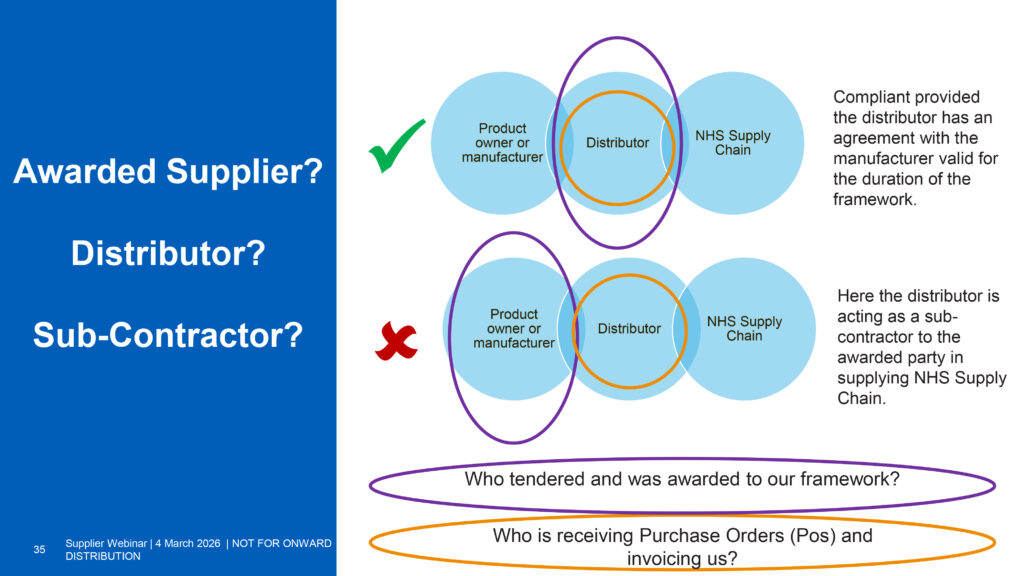
NHSSC indicated that this work is still under review and said any companies affected would be contacted individually. For BHTA members, the message is less about an immediate rule change and more about making sure contractual relationships, invoicing arrangements and framework responsibilities are aligned with the awarded supplier model.
Other webinar topics included the renaming of the Innovation Team to the Health Innovation Team Members also heard about NHSSC’s inbound logistics service, which provides end-to-end collection and delivery through a nationwide network used by more than 120 suppliers. The webinar also highlighted free support available through The King’s Trust, formerly The Prince’s Trust, which can help companies in high-need areas recruit young people into roles that support the health and social care sector, as part of its wider work to improve opportunities for young people in disadvantaged communities.

The NHS Supply Chain Supplier Webinar held in February 2026 provided suppliers with updates on several initiatives shaping procurement and supplier engagement across the health system. Topics included the NHS England Cyber Charter, the Supplier Performance Dashboard, developments in value-based healthcare, and a brief update on the NHS Core List.
Rachel Million, from the NHS Supply Chain Cyber Team, outlined the latest developments in NHS England’s Cyber Improvement Programme, which is driving higher standards of cyber resilience across the healthcare supply chain. Under the Cyber Charter, suppliers will be contacted by NHS England to discuss their cyber security controls and may be asked to provide evidence of compliance. Further detail is set out in NHS England’s open letter on the Cyber Improvement Programme (the Cyber Charter).
The programme aims to reduce the likelihood and impact of cyber incidents that could affect patient care. Suppliers were advised to review their information security measures, confirm certification status where applicable, and ensure they can provide evidence when requested. NHS Supply Chain noted that cyber resilience is now considered a core component of supply chain assurance.
Kate Mokrysz, Supplier Performance and Risk Manager, discussed the Supplier Performance Dashboard, which enables suppliers and NHS Supply Chain to view and compare performance data across cost, quality, service, and sustainability.
Current metrics include service levels, delivery performance, demand management, and data conformance. Further measures are expected to be added over the coming months, including product regulatory compliance, patient safety complaints, sustainability indicators, and information relating to supplier innovation pipelines.
Suppliers who wish to access their own performance data can request dashboard access via their NHS Supply Chain category contact.
Oliver Booth, Care Pathway Specialist (Midlands), discussed NHS Supply Chain’s ongoing work on value-based healthcare, which focuses on improving outcomes, efficiency, and total cost of care rather than unit price alone.
Suppliers were encouraged to bring forward solutions supported by robust evidence, including real-world data, patient experience, and economic modelling aligned to NHS priorities. Oliver highlighted NHS Supply Chain’s existing value-based healthcare portfolio, which includes case studies demonstrating measurable clinical and system benefits across stages such as pilot implementation, pathway optimisation, financial modelling, and benefits realisation.
NHS Supply Chain is continuing to build the next wave of value-based healthcare opportunities and encouraged suppliers to engage early and share strong evidence packs.
Fay Allen, Innovation Specialist, outlined a formalised Innovation Marketing Playbook designed to bring greater consistency and clarity to how innovative products are communicated within NHS Supply Chain.
A central element of the framework is the Innovation Brief, a structured document intended to present innovations in a clear, evidence-led format. Each brief includes an executive summary, classification of the innovation, key opportunity highlights, relevant clinical or economic evidence, and practical information such as ordering details and supporting guidance.
By standardising how innovations are presented, NHS Supply Chain aims to make it easier for NHS organisations to identify, assess, and adopt new technologies. For BHTA member suppliers, this approach may provide a clearer route for showcasing evidence-based products that align with value-based healthcare objectives.
Hamish Makanji, Head of Category – Medical and Surgical Consumables, provided a brief update on the NHS Core List, which aims to simplify procurement for standardised, high-volume consumables through a nationally coordinated route.
From the information presented, the Core List is intended for standardised consumables rather than specialist or bespoke clinical solutions. As many BHTA products, including assistive technology, rehabilitation, mobility, and complex care devices, are tailored to individual patient needs, they are less likely to fall within scope in the near term. While the Core List will continue to expand during 2026, its relevance to most BHTA members is expected to remain limited.
BHTA will continue to monitor NHS Supply Chain developments and share relevant updates to support members in understanding changes across the procurement landscape.