- Back
- Back
- Back
- Back
- Back
- Back
- Back
- Back
- Back
- Back
NHS Supply Chain’s March 2026 supplier webinar included a number of updates for suppliers, but two are particularly important for BHTA members: changes to the Economic and Financial Standing (EFS) guidance note, and clarification around distributor and subcontractor arrangements.
On EFS, NHS Supply Chain said the government guidance note on Economic and Financial Standing was updated on 31 December 2025, with NHSSC revising its own approach in response. NHSSC said the underlying methodology was first introduced through Procurement Policy Note guidance in 2023, later embedded into the Procurement Act 2023, and has been reflected in its Invitation to Tender documentation since spring 2024.
NHSSC said it uses EFS to assess suppliers’ overall risk rating by testing and scoring five key financial ratios alongside a Dun & Bradstreet Failure Score, using the bronze scale. It said this is not a pass/fail measure for general award, but a contract management and risk tool. However, NHSSC noted that a supplier rated High, its highest level of concern, could still be excluded from mini competitions held after a general award.
NHSSC also said customers can ask to see a supplier’s EFS rating as part of their due diligence. Suppliers that are concerned about receiving a low score, or know they typically score red against some financial characteristics, can speak to NHSSC in advance through their Category Manager, provided this happens before they are in tender.
The main change is that the updated guidance now explicitly applies to framework-based awards. NHSSC said it will continue using the same tests as before, but with updated parameters, and the new ratios are set out in the revised guidance note. Suppliers can compare the old and new versions side by side to understand what has changed.
NHSSC said it will not amend its documentation or testing before 1 April 2026. It described the revised thresholds as generally tighter for the strongest ratings, while also saying that the changes appear limited in practice. Based on a broad sample of more than 500 current suppliers, fewer than 20 saw a change in their overall rating, with as many ratings improving as worsening.
The webinar also included an early heads-up on NHSSC’s compliance work around distributor and subcontractor arrangements within tenders. In simple terms, NHSSC should only pay invoices issued by an awarded supplier.
Where a distributor supports the party that has tendered for and secured a place on a framework, NHSSC said that distributor is effectively acting as a subcontractor. According to the example shared in the webinar, this arrangement is compliant provided the distributor has an agreement with the manufacturer that remains valid for the duration of the framework.
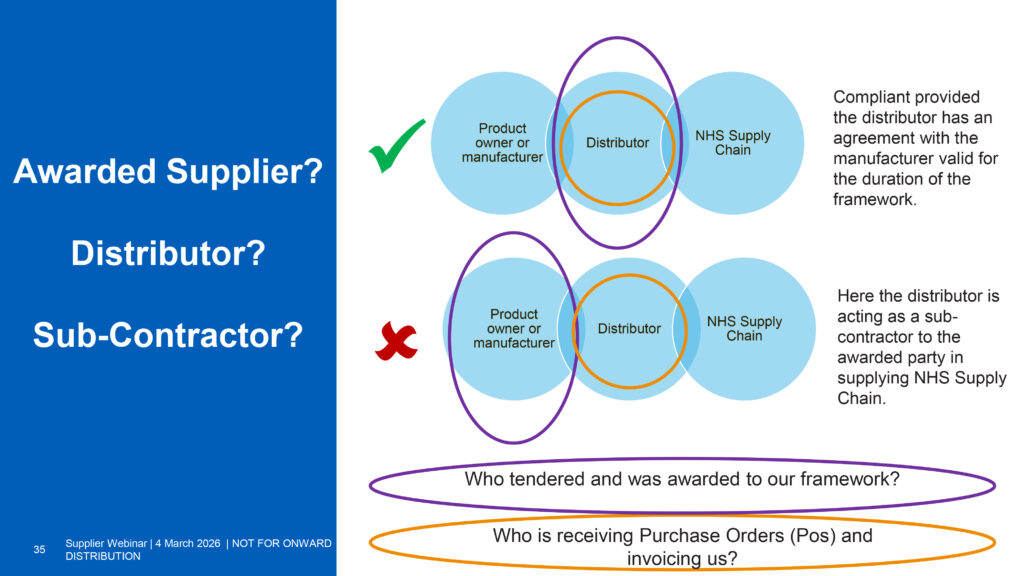
NHSSC indicated that this work is still under review and said any companies affected would be contacted individually. For BHTA members, the message is less about an immediate rule change and more about making sure contractual relationships, invoicing arrangements and framework responsibilities are aligned with the awarded supplier model.
Other webinar topics included the renaming of the Innovation Team to the Health Innovation Team Members also heard about NHSSC’s inbound logistics service, which provides end-to-end collection and delivery through a nationwide network used by more than 120 suppliers. The webinar also highlighted free support available through The King’s Trust, formerly The Prince’s Trust, which can help companies in high-need areas recruit young people into roles that support the health and social care sector, as part of its wider work to improve opportunities for young people in disadvantaged communities.

The NHS Supply Chain has announced a one‑hour pre‑market engagement (PME) webinar introducing the forthcoming Aids for Daily Living (ADL) 2027 framework, scheduled for 2pm on 10 February 2026. This session offers BHTA members an opportunity to understand the scope, timelines, and participation process for this major upcoming framework.
The ADL 2027 framework aims to support independence at home and facilitate timely hospital discharge through a comprehensive range of products. Categories will include bathing aids, toileting aids, bedroom and home equipment, mobility aids, and paediatric devices, as well as a managed service for Community Equipment Loan Services.
The framework also places a strong emphasis on reuse, refurbishment, and sustainability, aligned with NHS Supply Chain’s circular economy and design for life principles — part of a wider shift toward sustainable procurement and product lifecycle thinking that the NHS and medtech sector are pursuing together (read more about the Design for Life initiative here).
The webinar will provide an overview of the framework’s commercial aims, specifications and product categories, the procurement process, and key milestones. It will also outline how members can engage during the PME period, which remains open until 6 March 2026. This session forms part of NHS Supply Chain’s wider engagement programme.
BHTA members involved in the supply of aids for daily living, mobility aids, community equipment, or related products and services are encouraged to attend. The session is particularly relevant for organisations working in assistive technology, rehabilitation, independent living, or healthcare product distribution, including small and medium‑sized enterprises (SMEs) and voluntary, community and social enterprises (VCSEs).
To attend, members should register their Expression of Interest (EOI) via either the Jaggaer portal or the Find a Tender notice.
Once registered, attendees can sign up for the webinar through the official Microsoft Teams event link.
For any questions ahead of the session, please contact the NHS Supply Chain Aids for Daily Living team at aidsfordailyliving@supplychain.nhs.uk.
BHTA members are encouraged to participate in this engagement opportunity. The association will continue to monitor updates on the framework and share relevant information as procurement progresses.
The latest NHS Supply Chain (NHSSC) supplier webinar, held on 3 December 2025, provided essential updates for suppliers on cybersecurity compliance and sustainability expectations. The session, part of NHSSC’s regular information series, featured speakers from its Cyber Security and Sustainability teams, offering insight into upcoming requirements that suppliers will need to meet to remain eligible for tenders and contracts.
Jennie Lewis, Cyber Security Compliance Coordinator at NHS Supply Chain, led the session’s opening presentation on supplier cybersecurity. She outlined NHSSC’s adoption of the UK Government’s Procurement Policy Note (PPN) 014, which sets out new baseline security expectations for all suppliers in scope.
All suppliers handling personal information or providing ICT systems and services will be required to demonstrate compliance with Cyber Essentials Plus — a government-backed certification that confirms an organisation has robust cybersecurity controls in place. Certificates must be renewed annually and verified through an external audit. Suppliers can confirm certification validity via IASME, the national accreditation body.
Suppliers processing NHS patient data will also need to complete the Data Security and Protection Toolkit (DSPT), an NHS England-mandated self-assessment to evidence responsible data handling and compliance with information governance standards. For questions on data or security requirements, suppliers can contact cybersecurity@supplychain.nhs.uk.
Where suppliers do not yet hold Cyber Essentials Plus or DSPT certification, NHS Supply Chain has introduced an Information Security Third Party Questionnaire (ISTPQ). This pass/fail assessment, completed at the Supplier Questionnaire stage of a tender, will be reviewed by NHSSC’s Cyber Security Team to assess equivalency to Cyber Essentials standards. NHSSC will take a risk-based approach to non-compliance, weighing the criticality of the product or service against potential cyber risk. However, suppliers without certification may face reduced opportunities for participation in future tenders.
The Cyber Security Team also confirmed that NHS England will be notified of any vulnerable or insecure products or services identified through this process, as part of broader efforts to strengthen supply chain resilience across the NHS.
The second presentation, delivered by Jade Gaffney, Sustainability Advisor, and Heidi Barnard, Head of Sustainability, explored the Evergreen Sustainable Supplier Assessment, one of five key sustainability criteria suppliers must meet. The “Five Asks” — covering Carbon Reduction Plans, Social Value, the Evergreen Assessment, Horizon Scanning, and Modern Slavery — are central to NHS England’s net zero and sustainability strategy.
From 1 April 2026, all suppliers bidding for new NHSSC tenders will be required to achieve Evergreen Level 1 or above. Level 1 aligns with the Carbon Reduction Plan requirements, meaning suppliers must publicly commit to achieving net zero carbon emissions by 2050 for all scopes. Suppliers unable to meet this requirement will remain eligible for existing contracts but may be excluded from new tenders after this date.
The Evergreen Assessment is hosted on the Atamis platform, accessible under the Information section. NHSSC advised suppliers to ensure their Evergreen submission is correctly linked to their Atamis account to prevent data visibility issues. Annual updates are mandatory, with no automatic reminders issued. Suppliers gathering Scope 3 emissions data should enter “0” placeholders where figures are unavailable, ensuring the assessment remains complete. Queries about sustainability assessments can be directed to sustainability@supplychain.nhs.uk.
The Evergreen framework supports NHSSC’s goal of embedding environmental accountability throughout its supply base, ensuring that procurement decisions contribute directly to the NHS’s wider sustainability and net zero commitments.
The BHTA joined NHS Supply Chain’s (NHSCC) latest supplier webinar on 12 November 2025 to hear updates on key procurement developments. The session provided practical information to help suppliers understand upcoming changes, maintain compliance with NHS procurement standards, and engage more effectively with NHSCC.
Matthew Griffin, Head of Procurement Operations, outlined how NHSCC is helping suppliers adapt to changes brought about by the Procurement Act 2023. A series of new user guides, short videos, and updated website content has been created to make information easier to access. For more information and access to these supplier resources, visit the NHSCC suppliers section.
Matthew also emphasised NHSCC’s increasing focus on cyber security, with new requirements to safeguard systems and sensitive data. A dedicated section on the website provides guidance on meeting these standards. He highlighted the importance of early engagement with the UK Accreditation Service (UKAS) and recommended suppliers familiarise themselves with the Contract and Tender Process pages.
The updated procurement calendar was also noted as a useful tool showing NHSCC’s current and upcoming contract pipeline.
Tim Plackett, Performance and Risk Manager, underlined the importance of keeping supplier information up to date within the Central Digital Platform (CDP). Suppliers should ensure their company and product details, including insurance certificates, accreditations, and financial standing, remain current. This supports smoother tenders and contract management.
Tim encouraged suppliers to provide as much detail as possible, stating to suppliers that a good rule of thumb is to assume buyers know nothing about them. He clarified that Supplier Economic and Financial Standing (EFS) is not a pass or fail measure, but it may affect how NHSCC works with individual suppliers.
Category managers can also provide product data extracts at contract level to suppliers, including some information about competitors, though these exclude sensitive commercial information.
Byron Vincent, Head of Performance and Business Management, presented the Buying Principles, which reflect NHSCC’s commitment to more sustainable, fair, transparent, and effective procurement. The principles form part of NHSCC’s wider modernisation programme and align with national health objectives under the NHS 10-Year Plan.
Centred around three ambitions – Buy Smart, Supply Right, and Partner Expertly – the framework aims to deliver £1 billion in cumulative value to the NHS by 2030. Byron explained that NHSCC will place greater emphasis on value-based procurement, assessing the total value of products and services rather than focusing solely on cost.
The seven buying principles are: