
- Back
- Back
- Back
- Back
- Back
- Back
- Back
- Back
- Back
- Back

The Health Bill completed its House of Commons stages on 8 September, following two days of Report Stage debate covering medical device regulation, NHS structures, procurement, commissioning, community services, and social care.
During the 7 September debate, MPs considered NHS procurement, integrated care boards (ICBs), community equipment, and wheelchair services. The 8 September debate brought further developments, including new provisions covering medical device regulation.
Several developments across the two days are particularly relevant to BHTA members.
One of the most significant changes came on 8 September, when MPs agreed New Clause 94, tabled by the UK Government, establishing the statutory foundation for a future medical device licensing regime in Great Britain.
The new powers would allow regulations to require product licences for supplying or advertising medical devices, alongside personal licences for activities including manufacturing, importing, wholesale dealing, and conducting clinical investigations. Regulations could also cover licence conditions, safety and performance monitoring, enforcement, exemptions, and a public register.
Minister for Secondary Care Karin Smyth MP said the framework is intended to replace the current regulatory regime in Great Britain, with the detail to be developed through regulations in consultation with patients, healthcare professionals, and the medical device sector.
The provisions apply to Great Britain, while EU medical device legislation will continue to apply in Northern Ireland under the Windsor Framework.
MPs also agreed New Clause 98, providing a clearer legal framework for sharing medical device information with UK health systems, organisations, and trusted international partners.
Community equipment and wheelchair provision received detailed attention on 7 September.
Daniel Francis MP, Chair of the All-Party Parliamentary Group for Wheelchair Users and the All-Party Parliamentary Group for Access to Disability Equipment, spoke in support of Amendment 32 and New Clause 39. These proposed an 18-week timeframe for providing community equipment and wheelchair services, alongside published local standards and annual reporting by ICBs.
Daniel highlighted evidence gathered for an inquiry by the APPG for Access to Disability Equipment last year. One in three equipment users who responded reported waiting a significant amount of time for equipment, while one in five had waited more than two months. He also said 74 percent of responding professionals and equipment providers had seen hospital discharge delayed because essential equipment was unavailable in a person’s home.
Daniel highlighted local variation, describing pupils attending the same school and living within the same ICB area receiving different wheelchair service standards because they lived in neighbouring boroughs.
For the purposes of the proposals, community equipment was defined broadly to include products and adaptations such as wheelchairs, specialist seating, hoists, hospital beds, pressure-relieving equipment, and home adaptations.
Neither proposal was agreed as an amendment to the Bill, although Karin said she would write to Daniel about the government’s plans for ICBs to improve the situation.
Karin said the Chancellor had asked the Health Secretary to consider how NHS procurement could better support British industry. The Health Secretary has commissioned a review of strategic procurement pipelines to identify opportunities for a new social value model supporting British jobs, skills, and innovation.
For BHTA members supplying the NHS, the development of this model could influence how social value, domestic economic contribution, skills, and innovation are considered in future procurement.
The abolition of NHS England (NHSE) is a central part of the Bill, with its functions due to transfer elsewhere in the health system, including to the Department of Health and Social Care.
MPs scrutinised how that transition would work in practice. Proposals included a transition strategy to protect NHSE’s expertise and organisational knowledge, an assessment of the costs and savings of abolition, and a health and social care integration plan addressing joint commissioning, delayed hospital discharge, and additional responsibilities for ICBs.
Social care proposals included New Clause 63, which called for government plans covering respite care, Carer’s Allowance, free personal care, and a cap on care costs. These proposals were not incorporated into the Bill.
There was, however, an agreed change affecting ICB governance. Government amendments retained a requirement for each ICB to include at least one member jointly nominated by local authorities in its area, alongside a member nominated by a mayoral strategic authority.
Danny Beales MP welcomed the change and raised the broader question of which functions should remain nationally organised and which should be devolved to ICBs following the abolition of NHSE. He highlighted the benefits of national commissioning where consistent standards and delivery at scale are required.
For BHTA members, the eventual division of responsibilities could affect how products and services are commissioned, and whether suppliers engage with national bodies, individual ICBs, or other parts of the health system.
The Health Bill passed its Commons Third Reading on 8 September and received its formal First Reading in the House of Lords on 9 September. Its Lords Second Reading is scheduled for 13 October, before detailed scrutiny begins.
For BHTA members, key areas to follow include medical device licensing, NHS procurement and social value, the transfer of NHSE’s functions, ICB responsibilities, and community equipment and wheelchair provision.
BHTA will continue to monitor the Bill as it progresses through Parliament and provide updates on developments affecting members.

This paper, produced by the British Healthcare Trades Association and the Wheelchair Alliance, explains how community equipment services (CES) and wheelchair services are funded, commissioned, and delivered, highlighting key differences to improve public understanding and support informed policymaking. It focuses on public services in England and does not cover private sector provision.
While CES and wheelchair services both play an important role in supporting independence and meeting people’s health and care needs, they are distinct services with different structures, responsibilities, and routes of access.
The guidance provides an accessible overview of how each service operates in England, including who is responsible for commissioning services, how provision is organised, and how people are referred to or access support. It also considers how eligibility and individual needs are assessed, and where responsibility for clinical decision-making sits.
Another key theme is the way the two services approach personalisation, choice, and funding. The paper highlights where the models differ and why CES and wheelchair services should not be viewed as interchangeable, despite some similarities in the people and needs they support.
Bringing these themes together, the guidance offers a clear comparison of the two service models and is intended to support a better understanding among policymakers, commissioners, healthcare professionals, providers, and other stakeholders.

MPs have urged the government to consider a national strategy for disability equipment provision after a Westminster Hall debate highlighted delays in wheelchair services, shortages in housing adaptations, and inconsistent access to assistive equipment across the UK.
Opening the debate, Seamus Logan MP said disability equipment plays a crucial role in supporting independence and quality of life for millions of people.
“Around 25% of the UK population are disabled,” Seamus said ahead of the debate. “The provision of disability equipment is of paramount importance to many across the UK. When provided, it can significantly improve quality of life and independence.”
Seamus said the debate would focus particularly on wheelchair provision, housing adaptations, and wider barriers disabled people face when trying to access equipment that enables everyday living.
Several MPs used the debate to highlight long waiting times and uneven access to equipment depending on where people live.
John Hayes MP pointed to NHS England data suggesting that around 70% of wheelchair users wait more than three months for equipment, while roughly 30% wait longer than six months, and around 15% more than a year.
MPs argued that these delays can significantly affect independence, employment, and daily life for disabled people.
Jim Shannon MP said that while appropriate equipment can transform lives, many people with complex needs are waiting too long to receive it. In some cases, Jim noted, individuals have resorted to crowdfunding to obtain suitable wheelchairs.
Helen Maguire MP highlighted wider structural pressures affecting services, including staffing shortages, supply chain issues, and variation in local authority processes, which Helen said were contributing to delays and inconsistent provision.
Daniel Francis MP, chair of the All-Party Parliamentary Group (APPG) for Access to Disability Equipment, argued that the current system is fragmented and lacks clear national direction.
Drawing on findings from the APPG inquiry (see the full report: APPG for Access to Disability Equipment report), Daniel said the collapse of major supplier NRS Healthcare had exposed weaknesses in the current model of provision.
Daniel and other MPs called for the government to consider introducing a national strategy for community equipment to improve oversight, strengthen accountability, and ensure more consistent access for disabled people.

Housing adaptations were also raised as a significant challenge during the debate. MPs pointed to shortages of adapted housing, long waits for assessments, and cases where people were told necessary adaptations could not be carried out.
Some contributors warned that even when adaptations are delivered, they are not always designed in ways that genuinely improve independence and quality of life.
Responding for the Government, Social Care Minister Dr Zubir Ahmed acknowledged that some wheelchair services are underperforming and that waiting times in parts of the system remain too long.
However, he defended the current structure in England, where integrated care boards commission services to meet local health needs, while local authorities hold statutory duties for providing community equipment in the home.
The minister said NHS planning guidance already requires integrated care boards to reduce waiting times for wheelchair services, with performance monitoring due to be strengthened from 2026–27.
He also pointed to increased use of Personal Health Budgets, and confirmed that £723 million in Disabled Facilities Grant funding would be available in 2026–27 to support housing adaptations.
While he stopped short of committing to a national strategy, the minister said he would write to colleagues responsible for disability policy and quality frameworks to share concerns raised during the debate.
The debate underscored growing concern across Parliament about delays, fragmentation, and accountability in disability equipment provision.
For the sector, the discussion signals increasing political attention on the need for more coordinated planning, improved procurement resilience, and better access to assistive technology that enables disabled people to live independently.

A recent House of Lords debate on the English Devolution and Community Empowerment Bill has highlighted long-standing challenges in wheelchair and community equipment provision — and how a proposed amendment could help address them.
Amendment 165A to Clause 44 of the Bill, tabled by Lord Hunt of Kings Heath, would add the following to the list of “general health determinants” that authorities must consider when addressing health inequalities:
“(f) the degree of ease or difficulty with which persons have access to high quality wheelchair and community equipment provision.”
This amendment would include wheelchair and community equipment provision in the list of ‘general health determinants’ that authorities need to have regard to as a cause of health inequality.
Peers from across the House voiced support for the amendment, describing the current state of wheelchair and community equipment provision as fragmented, inconsistent, and underfunded.
Watch the debate from 19:56:28 via this link: https://parliamentlive.tv/event/index/dacc4873-aaf6-4230-83a1-46ad665ad36b?in=19:56:28
Lord Hunt of Kings Heath called the current system “a disgrace,” citing evidence from the Wheelchair Alliance and the All-Party Parliamentary Group for Access to Disability Equipment showing the lack of national standards, independent regulation, and clear repair or complaints processes. “Many disabled people face long waiting times, delays in hospital discharge, loss of independence, social isolation and avoidable deterioration in health and well-being,” he said.
He explained that wheelchair and community equipment services, though often reaching the same individuals, are managed separately — one primarily by the NHS, the other by local authorities and integrated care boards. This division, he argued, leads to inefficiency and poor outcomes. “They should operate in tandem, but they are two distinct systems,” he said, urging closer collaboration.
Lord Shinkwin, speaking as a wheelchair user, said the amendment “puts the issue on the radar,” adding that access to wheelchair and community equipment services “is a health inequality issue.” He warned that the system’s fragmentation and lack of accountability have allowed inequality to become normalised. “Fragmentation may make for better ICB balance sheets in the short term, but history shows that, in the medium term, it is a very costly false economy.”
Baroness Griffin of Princethorpe added that one in three disabled people are still waiting for approved equipment, and that 74 percent of delayed hospital discharges are linked to equipment delays. The amendment, she said, would help make this area of provision a recognised factor in tackling health inequalities.
Responding for the UK Government, Baroness Taylor of Stevenage acknowledged the concerns but said existing legislation already requires provision of such services. In her response in the House of Lords, she said:
“Local authorities in England already have a statutory duty under various legislation, including the Care Act 2014 and the Children and Families Act 2014, to make arrangements for the provision of disability aids and community equipment to meet the assessed eligible needs of individuals who are resident in their area. In terms of delivery, NHS England supports integrated care boards and wheelchair providers to reduce regional variation in the quality and provision of NHS wheelchairs and to reduce delays in people receiving timely intervention and wheelchair equipment.”
She added that she would raise the issues with colleagues in DHSC and MHCLG and confirmed that the Bill’s existing scope already allows for access to equipment to be considered under “general health determinants.”
Watch Baroness Taylor’s response to Amendment 165A from 16:06:27 via this link: https://parliamentlive.tv/event/index/49b1e807-8829-4a75-a307-4a738052e65b?in=16:06:27
If accepted, Amendment 165A would:
The amendment remains under consideration as the Bill progresses through the House of Lords. Its debate marks an important acknowledgment of the essential role that wheelchairs and community equipment play in tackling health inequalities. The BHTA will update members if the amendment is accepted into the Bill.
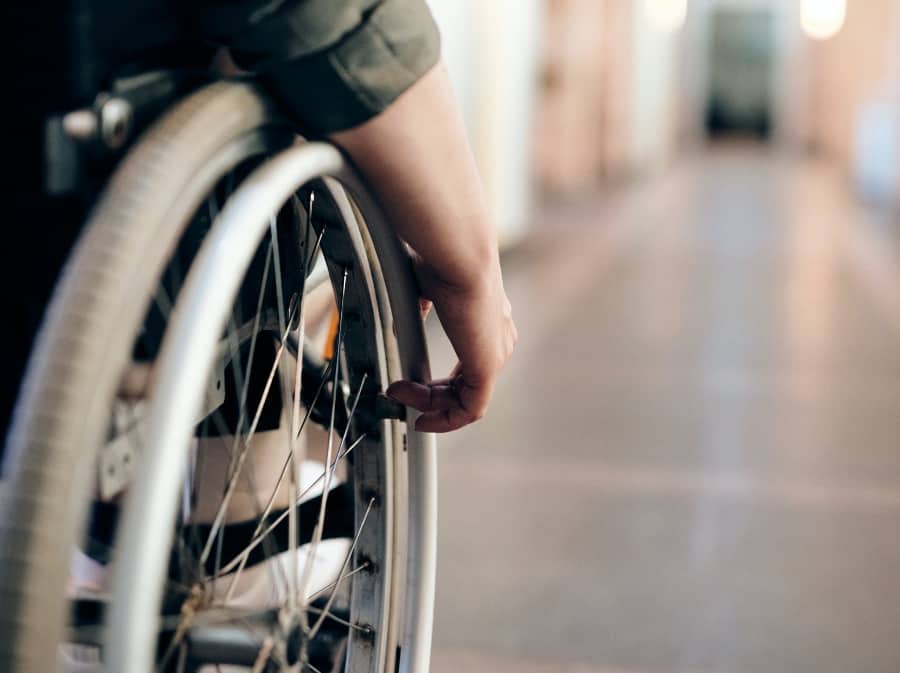
The wheelchair sector has responded to a recent BBC news report that highlights how thousands of people across the UK are experiencing long waiting times for crucial mobility equipment, as the NHS faces tighter budgets and higher demand.
In the most recent quarter (January-March 2025) in England, 77.9 percent of children and 80.8 percent of adults received an NHS wheelchair, or a modification to their wheelchair, within 18 weeks. This is below the 92 percent target set out by NHS England.
A large contributing factor to these delays is a lack of funding from the UK Government for vital NHS wheelchair services, which means providers do not have sufficient resources to deliver them effectively and timely.
The Wheelchair Alliance is a community interest company with a goal of improving wheelchair provision in England. Its vision is to transform the experience of wheelchair users in England through improved access, quality, and effectiveness of services.
Nick Goldup, CEO of the Wheelchair Alliance, said: “The Wheelchair Alliance is working hard to ensure people receive better provision of wheelchairs through the NHS, and we often hear of long waits for appointments and receipt of a wheelchair. Wheelchair users are often faced with a complex and complicated system to navigate.
“The NHS refers regularly to the use of Personal Wheelchair Budgets (PWBs) as a mechanism to help people receive the wheelchairs they need; however, these are very limited in their application as the rules often prevent wheelchair users from getting what they want.
“For example, in Ivy’s case, Ivy would benefit from a powerchair but would be prevented by the PWB rules from upgrading her manual chair to powered and, if she decided to take the PWB externally to buy a powered chair, the money offered by the NHS would come nowhere near to how much she would need. This results in an inequality.
“In short, PWBs can be good for people with money, but for those with limited funds they offer no solutions.
“The Wheelchair Alliance is lobbying government for ownership and accountability of wheelchair services at a senior, national level, to take responsibility for a broken system. We have also been working hard towards driving improved commissioning of services through developing a Quality Framework that we hope the NHS will use to make wheelchair provision more consistent and fair.
“Lastly, our research and reports have shown that much of the data around demand for wheelchair services is estimated. We need reliable data to form an accurate local and national picture, as well as improved budgets.”
BHTA member AJM Healthcare has also responded. AJM Healthcare is an NHS wheelchair services provider in the UK, specialising exclusively in wheelchair services.
Guy Eatherington, Business Development & Customer Relations Director at AJM Healthcare, commented: “AJM Healthcare is committed to supporting the ongoing national redevelopment and reform of wheelchair services.
“The data presented below highlights a concerning trend across the system: a significant number of service users are not receiving the equipment they need within appropriate timeframes. This delay in provision undermines both the quality of care and the independence of individuals relying on these essential services.
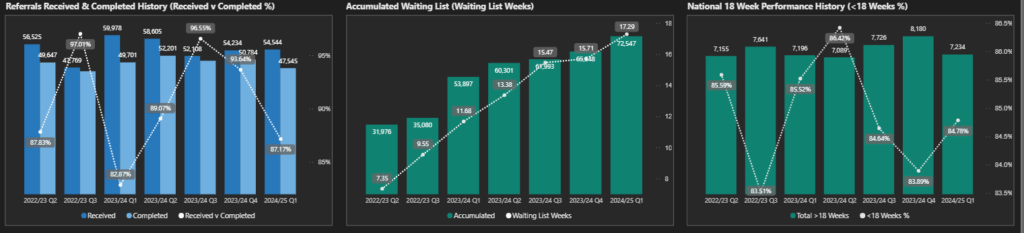
“One key metric of referrals received versus referrals completed, has shown a peak performance of 97 percent. However, the average completion rate over the past two years stands at just 90.59 percent, indicating a persistent gap in service delivery.
“More than three-quarters of wheelchair services across England are currently delivered by NHS trusts or other publicly funded or third-sector organisations. This reflects the significant role that non-private entities continue to play in the provision of the NHS wheelchair services provision nationwide.
“More critically, the national waiting list has grown substantially during this period. An additional 40,000 individuals have been added to waiting lists across the country, reflecting mounting pressure on services and a growing unmet need.
“AJM Healthcare recognises the urgency of these challenges and remains dedicated to working collaboratively with commissioners, providers, and service users to drive meaningful improvements. Our goal is to ensure that every individual receives timely access to the right equipment, enabling greater mobility, independence, and quality of life.”
David Stockdale, Chief Executive of the British Healthcare Trades Association (BHTA), added: “Stories like this are deeply concerning, and they reflect what our members tell us: demand for NHS wheelchair services is rising, but funding has not kept pace.
“Clinicians and providers work hard within tight constraints; the issue is not a lack of commitment on the frontline, but a lack of sustained, adequate investment. Without funding to meet increasing need and costs, services struggle to recruit, retain, and innovate, and people wait too long for the essential equipment that enables independence, safety, and participation in daily life.
“We urge the government to prioritise wheelchair provision by increasing budgets, setting clear national accountability for delivery, and supporting consistent commissioning so that access is fair across the country. With the right resources, the system can reduce waiting times, provide the right chair first time, and ensure that every wheelchair user receives timely, person-centred support.”