- Back
- Back
- Back
- Back
- Back
- Back
- Back
- Back
- Back
- Back
NHS Supply Chain (NHSSC) has confirmed that Unite has suspended its planned industrial action following discussions with GXO. Unite will now ballot its members on a revised pay deal.
The suspension supersedes the strike schedule outlined below. It follows the earlier postponement of the action scheduled for 13–15 October.
NHSSC has confirmed that trusts will receive deliveries according to their normal schedules and should continue to order as usual. Trusts with questions should contact their customer services advisor.
NHSSC will continue to monitor the situation and inform partners of significant developments. Members can visit NHSSC’s announcement for further updates.
NHSSC has announced six periods of industrial action by Unite members employed as drivers by its logistics provider, GXO, following a pay dispute.
NHSSC has warned of potential disruption to deliveries to NHS customers. However, NHSSC told suppliers at its webinar on 7 October that its depots would remain open during strike days.
The planned strike periods are:
Each period is scheduled to begin at 4pm on the first day and end at 8pm on the final day.
In its announcement, NHSSC said customers facing disruption would be contacted during the preceding week to discuss contingency arrangements and possible changes to deliveries.
It said its customer services team had already contacted all trusts affected by the first strike period, from 13 to 15 October. Partners that had not been contacted would receive deliveries as normal.
NHSSC said GXO remained committed to discussions with Unite and ACAS to resolve the dispute. NHSSC will continue to monitor developments and update partners.
NHS Supply Chain’s March 2026 supplier webinar included a number of updates for suppliers, but two are particularly important for BHTA members: changes to the Economic and Financial Standing (EFS) guidance note, and clarification around distributor and subcontractor arrangements.
On EFS, NHS Supply Chain said the government guidance note on Economic and Financial Standing was updated on 31 December 2025, with NHSSC revising its own approach in response. NHSSC said the underlying methodology was first introduced through Procurement Policy Note guidance in 2023, later embedded into the Procurement Act 2023, and has been reflected in its Invitation to Tender documentation since spring 2024.
NHSSC said it uses EFS to assess suppliers’ overall risk rating by testing and scoring five key financial ratios alongside a Dun & Bradstreet Failure Score, using the bronze scale. It said this is not a pass/fail measure for general award, but a contract management and risk tool. However, NHSSC noted that a supplier rated High, its highest level of concern, could still be excluded from mini competitions held after a general award.
NHSSC also said customers can ask to see a supplier’s EFS rating as part of their due diligence. Suppliers that are concerned about receiving a low score, or know they typically score red against some financial characteristics, can speak to NHSSC in advance through their Category Manager, provided this happens before they are in tender.
The main change is that the updated guidance now explicitly applies to framework-based awards. NHSSC said it will continue using the same tests as before, but with updated parameters, and the new ratios are set out in the revised guidance note. Suppliers can compare the old and new versions side by side to understand what has changed.
NHSSC said it will not amend its documentation or testing before 1 April 2026. It described the revised thresholds as generally tighter for the strongest ratings, while also saying that the changes appear limited in practice. Based on a broad sample of more than 500 current suppliers, fewer than 20 saw a change in their overall rating, with as many ratings improving as worsening.
The webinar also included an early heads-up on NHSSC’s compliance work around distributor and subcontractor arrangements within tenders. In simple terms, NHSSC should only pay invoices issued by an awarded supplier.
Where a distributor supports the party that has tendered for and secured a place on a framework, NHSSC said that distributor is effectively acting as a subcontractor. According to the example shared in the webinar, this arrangement is compliant provided the distributor has an agreement with the manufacturer that remains valid for the duration of the framework.
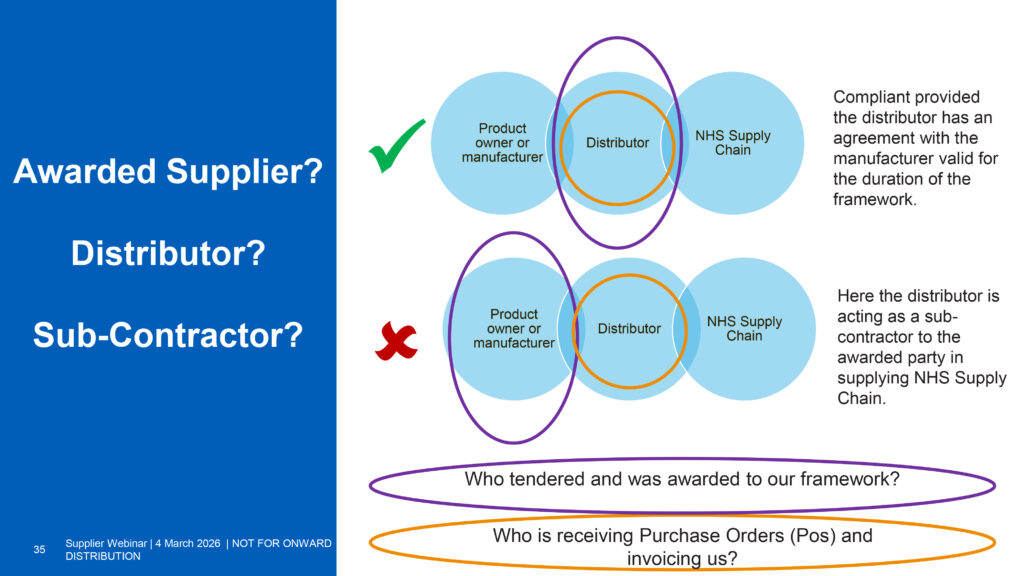
NHSSC indicated that this work is still under review and said any companies affected would be contacted individually. For BHTA members, the message is less about an immediate rule change and more about making sure contractual relationships, invoicing arrangements and framework responsibilities are aligned with the awarded supplier model.
Other webinar topics included the renaming of the Innovation Team to the Health Innovation Team Members also heard about NHSSC’s inbound logistics service, which provides end-to-end collection and delivery through a nationwide network used by more than 120 suppliers. The webinar also highlighted free support available through The King’s Trust, formerly The Prince’s Trust, which can help companies in high-need areas recruit young people into roles that support the health and social care sector, as part of its wider work to improve opportunities for young people in disadvantaged communities.