
- Back
- Back
- Back
- Back
- Back
- Back
- Back
- Back
- Back
- Back
Last Updated on 29/10/2026 by Sarah Sarsby
The British Healthcare Trades Association (BHTA) proposed collaboration to examine the wider lifetime value of paediatric equipment at the All-Party Parliamentary Group (APPG) for Access to Disability Equipment meeting on 27 October 2026.
Harriet Noon-Green, Policy Officer at the BHTA, represented the association. Discussions focused on children and young people’s access to essential equipment, the impact of frustrating delays on their everyday lives, and the BHTA’s proposal to investigate the wider benefits of timely, appropriate provision.
The meeting was chaired by Daniel Francis MP. Seamus Logan MP also attended, alongside Danny Beales MP’s Chief of Staff, who attended and took notes on his behalf.
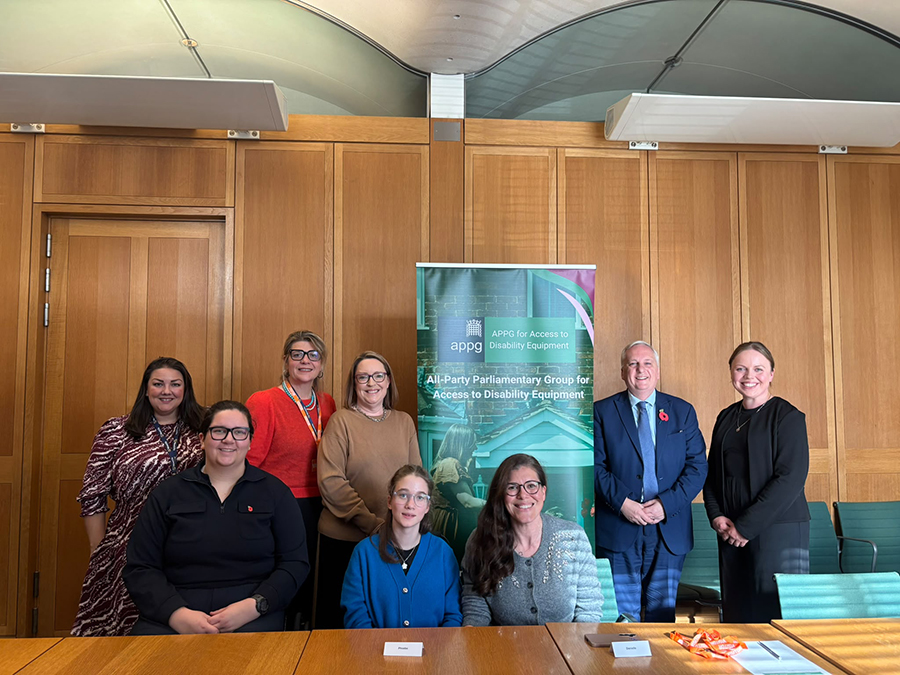
Harriet proposed collaboration between the BHTA and the APPG to explore how the wider lifetime value of paediatric equipment can be better understood, evidenced, and reflected in procurement and commissioning decisions.
Harriet outlined the proposition that the BHTA Children’s Equipment Section would like to test: timely provision of appropriate paediatric equipment can create value far beyond the original procurement decision. It may improve outcomes for children and families and reduce longer-term costs across health, social care, and education. Current procurement and commissioning arrangements do not consistently capture or recognise that wider lifetime value.
She asked the APPG to help convene the right partners and support an independent programme of evidence gathering to understand the true lifetime value of paediatric equipment, so that future decisions can be based on outcomes and whole-system value as well as initial purchase price.
Phoebe, a young wheelchair user, and her mother, Danielle, supported by Alice and Joanna Fashan from Whizz Kidz, shared their experiences of wheelchair services, equipment provision at home and school, and accessible transport.
Phoebe described frustrating delays and occasions when she felt her views were not heard during wheelchair appointments. She highlighted the importance of anticipating growth spurts as she gets older and ensuring her wheelchair can accommodate warmer clothing in colder months.
Phoebe emphasised that there can be no stronger knowledge than lived experience, and that her views and those of other equipment users should be heard and recognised when decisions are made about their needs.
Phoebe and Danielle spoke positively about support from her school, local authority, and NHS physiotherapists. However, the wider discussion highlighted differences between families’ experiences and the challenges created by fragmented responsibilities across health, education, and local authorities.
They also described difficulties accessing a suitable courtesy car while their family vehicle was being repaired. The replacement provided required a transfer using a side-door hoist, which they described as frightening and unsafe. They reported that the companies arranging courtesy cover were difficult to deal with and lacked knowledge of accessibility requirements, adding to the challenges facing the family.
Becky Smith, from Newlife the Charity for Disabled Children, presented research into the experiences of children and their families. Timeliness and access emerged as central concerns, with delays of up to 10 months reported; in some cases, children had outgrown equipment before it arrived.
Becky emphasised that equipment itself is not the outcome; the focus should be on the life opportunities unlocked by timely access to appropriate equipment. Delays can restrict children’s school attendance, social interaction, and participation in everyday activities, with consequences for their mental health, wellbeing, and independence.
Participants also stressed the need for disability equipment to be addressed within the upcoming Education Bill, reflecting its fundamental role in enabling children to attend school. The mental health implications of difficulties accessing equipment were highlighted as a key concern.