
- Back
- Back
- Back
- Back
- Back
- Back
- Back
- Back
- Back
- Back
Last Updated on 23/06/2026 by Sarah Sarsby
At the BHTA Joint Section Meeting 2026, held on 18 June 2026 at the British Motor Museum in Warwickshire, delegates heard from Dr Ianto Guy of TRL on the future regulation of micromobility.
The Joint Section Meeting brought together BHTA members from across the association’s healthcare and assistive technology sectors for networking, knowledge-sharing, and discussion on the trends, challenges, and opportunities shaping the industry.
Dr Guy’s session examined how upcoming legislation could affect mobility equipment users, manufacturers, and retailers. With the UK Government having committed to reviewing the regulations governing powered mobility devices and developing a new regulatory framework for micromobility, existing legislation no longer reflects the realities of modern mobility solutions.

Dr Guy explained that today’s regulatory landscape is fragmented. Existing legislation includes the Invalid Carriage Regulations (1988), Electrically Assisted Pedal Cycle (EAPC) Regulations, and L-category vehicle regulations, yet many newer mobility products sit between these categories.
This has created unintended barriers for users, including younger mobility scooter users, powered wheelchair users wishing to tow pushchairs, and people who could benefit from newer micromobility devices but are prevented from using them under current regulations.
The presentation also highlighted products that exist within a regulatory “grey area”, including power add-ons for wheelchairs, self-balancing devices, and some forms of e-scooter technology.
Research undertaken by TRL, funded by the Motability Foundation and supported by organisations including RiDC, Wheels for Wellbeing, the Wheelchair Alliance, RNIB, and Disability Rights UK, has explored how a more unified approach could support independent mobility.
One proposal explored during the session was a new Low-Speed Zero Emission Vehicle (LZEV) category. Rather than maintaining separate systems for disabled and non-disabled users, the framework would apply a single set of rules to low-speed mobility devices, including mobility scooters, powered wheelchairs, self-balancing devices, power add-ons, and conversion kits.
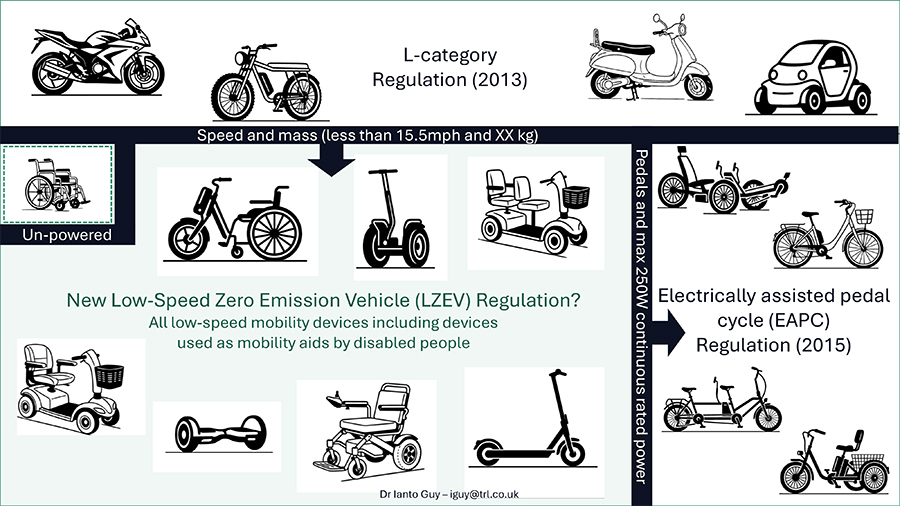
The proposal is underpinned by two ambitions: enabling everyone to achieve pedestrian-equivalent mobility for shorter journeys and cycling-equivalent mobility for longer journeys, regardless of whether they use a mobility aid.
Dr Guy argued that a single framework could help remove barriers created by the current system, giving users greater freedom to choose the device that best meets their needs, reducing the need to prove eligibility for certain mobility devices, and supporting innovation.
The discussion also focused on unresolved issues. One of the most debated was footway use. If a single regulatory system is adopted, policymakers will need to consider how different types of low-speed mobility devices can safely share space with pedestrians.
Another area of discussion was vehicle mass limits. Dr Guy explained that any future framework would likely need a maximum mass threshold to distinguish low-speed mobility devices from larger vehicle categories and help manage safety risks. However, the limit would need to accommodate heavier users and specialist mobility equipment without creating unnecessary barriers to access.
Questions also remain around infrastructure, public transport accessibility, and access to funding. As Dr Guy noted, regulation alone cannot address wider issues such as inadequate walking and wheeling infrastructure or barriers within public transport networks.
Even a successful regulatory overhaul would not solve every issue facing disabled people. Access to NHS and local authority funding, public transport, buildings, and suitable walking and wheeling infrastructure would remain significant considerations. While regulation can remove barriers created by the current system, wider improvements across transport, healthcare, and the built environment would still be needed.
Although no new legislation has yet been introduced, work is continuing across government and the sector to consider how future micromobility regulation could develop.
For BHTA members, the session highlighted that the future of micromobility is closely linked to wider questions of independence, accessibility, and inclusion.
As these discussions progress, the perspectives shared at the Joint Section Meeting reinforced the importance of collaboration between industry, researchers, disabled people’s organisations, and policymakers in shaping future mobility policy.