
- Back
- Back
- Back
- Back
- Back
- Back
- Back
- Back
- Back
- Back
The NHS is strengthening its commitment to innovation and efficiency through the introduction of new value-based procurement (VBP) standards for medical technology.
The Department of Health and Social Care (DHSC) has published the ‘Value Based Procurement Standard Guidance for Medical Technology’, designed for use within the NHS’s 13 VBP pilots. Although the guidance has been created to support these pilot projects, it also provides valuable insights and practical applications for the wider medical technology sector.
The guidance is intended for use by both NHS buyers and suppliers to help assess not only the cost of medical devices but also the broader value they deliver to patients, staff, and the healthcare system.
This shift towards value-based decision-making comes alongside the government’s announcement that the NHS will invest in pioneering technology to help reduce waiting lists and improve productivity across services. Together, these initiatives aim to ensure that procurement decisions increasingly reward technologies that demonstrate measurable improvements in outcomes, efficiency, and sustainability.
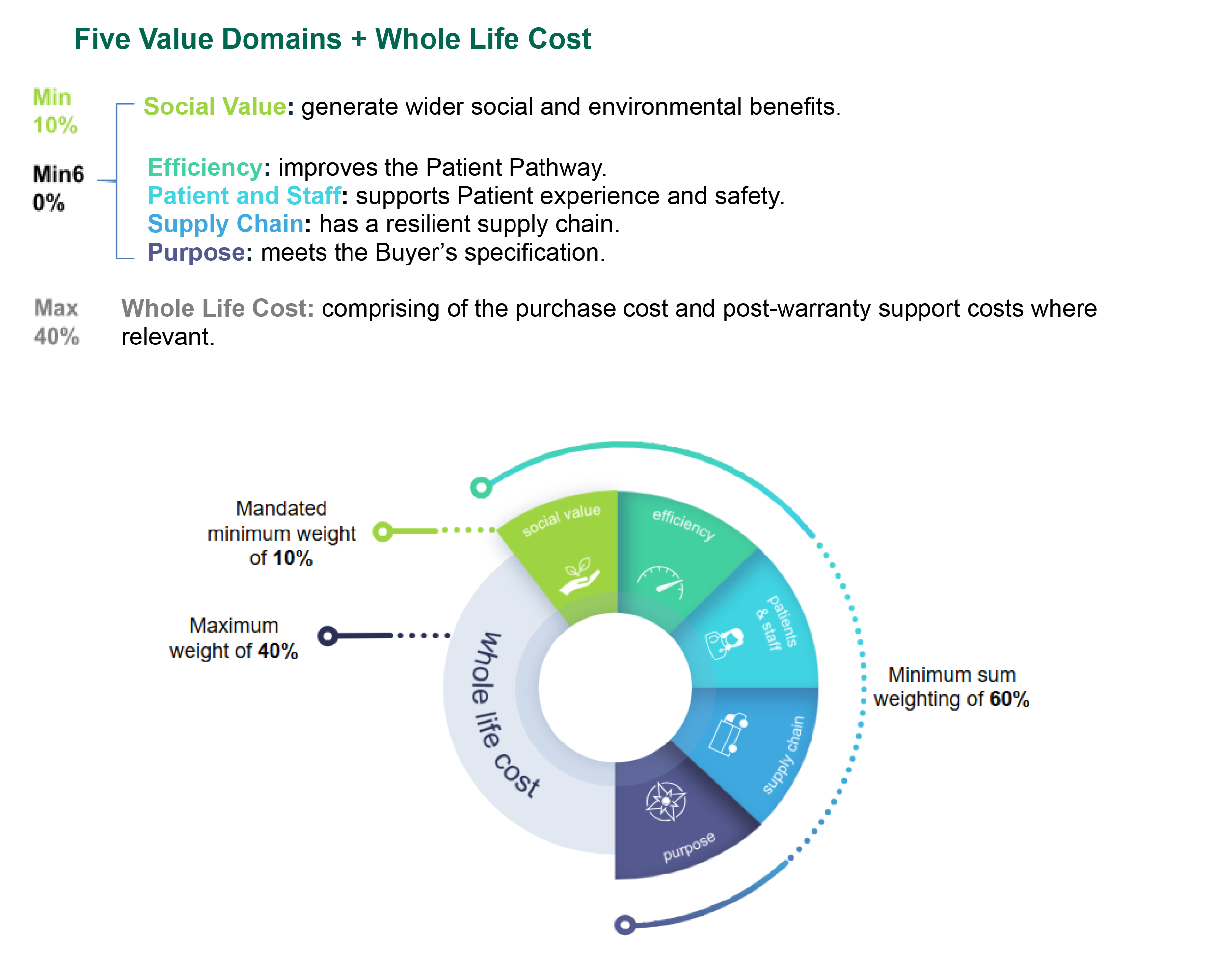
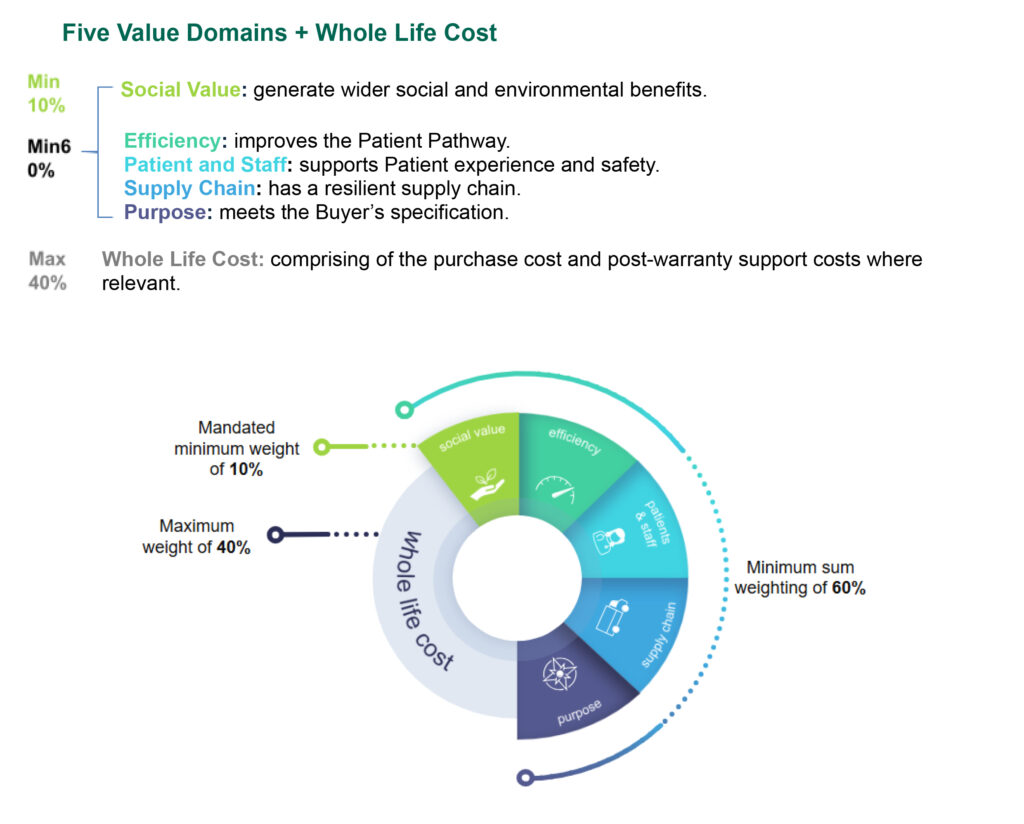
The new DHSC guidance establishes a framework for evaluating medical devices across five domains: social value, efficiency, patient and staff outcomes, supply chain resilience, and purpose. A sixth factor, whole-life cost, complements these domains by ensuring that price is considered within the broader context of lifecycle value.
Under the new framework, NHS buyers are encouraged to assess tenders not solely on upfront cost but on the overall contribution a product or service makes to the health system.
Each domain can be weighted according to the needs of a particular procurement, but social value must account for at least 10 percent of the total weighting, in line with the NHS Social Value Playbook. Overall, at least 60 percent of procurement scoring must relate to the value domains, while whole-life cost is capped at 40 percent.
This marks a step away from purely price-driven procurement and towards a model that prioritises long-term outcomes, sustainability, and patient benefit.
Each of the five value domains provides a structured set of questions and evaluation criteria for buyers and suppliers. The social value domain encourages suppliers to demonstrate how they will reduce carbon emissions, manage modern slavery risks, or improve sustainability in packaging and disposal. The efficiency domain considers how a product can simplify patient pathways, increase hospital or community productivity, and support accurate measurement of outcomes. The patient and staff domain emphasises safety, patient experience, and health equity, while supply chain and purpose focus on resilience, interoperability, and ease of use.
Suppliers are expected to provide measurable, evidence-based responses that show how their technologies can deliver tangible improvements. This includes providing baseline data, real-world evidence, and models that quantify benefits such as reduced complications, improved patient satisfaction, or optimised workforce time.
The guidance is part of a wider shift within the NHS towards integrating innovation, sustainability, and productivity.
Andrew New, CEO of NHS Supply Chain, said: “Innovative technology has a vital role to play in delivering faster, simpler and more effective care for patients. Through this new approach, we can ensure that procurement not only secures the best value for money but also supports the NHS in achieving its long-term goals around efficiency, sustainability and patient outcomes.”
BHTA member companies supplying medical technology to the NHS will need to engage more deeply with buyers to demonstrate measurable value through data, evidence, and partnership. This includes clearly articulating how their products support clinical efficiency, improve patient experience, and align with NHS sustainability objectives.
The framework also highlights the importance of collaboration between suppliers, clinical teams, and procurement professionals. Bidders are encouraged to provide evidence that supports their claims, including quantitative data, modelling, and independent validation where possible.
The guidance advises buyers to ensure proportionality in their tender requirements to support the participation of small and medium-sized enterprises (SMEs) within the medtech sector.
Suppliers may wish to focus on areas such as:
By preparing evidence-rich submissions aligned to the five value domains, suppliers can better position themselves to succeed in NHS tenders under this new approach.
The VBP guidance underscores a wider movement within the healthcare system towards smarter, more sustainable procurement. As the NHS aims to make better use of technology to enhance care delivery, these frameworks are helping to ensure that procurement decisions reflect genuine long-term value.
Andrew added: “By focusing on value rather than volume, we are creating the conditions for innovation to thrive — enabling suppliers to bring forward solutions that improve outcomes for patients and deliver efficiencies for the NHS.”

At the recent joint British Healthcare Trades Association (BHTA) and AXREM conference, David Lawson, Director of Medical Technology and Innovation at the Department of Health and Social Care (DHSC), set out the evolving landscape for medical technology.
‘The Future of MedTech – Innovating for Tomorrow’ conference was held on 13 May 2025 at The Mercure, Northampton.
David’s presentation was the final part of a compelling conference talk titled ‘Big Picture: What is the Future Policy Landscape for Medtech?’. The previous speaker, Nata Zaman, discussed NHS England’s New Hospital Programme and what that means for medtech.
David reflected on the MedTech Strategy alongside and some of the upcoming and ongoing DHSC initiatives that are crucial to medtech businesses across the UK.
Despite the frequent changes in ministers and departmental structures over the past few years, the original challenges identified in the MedTech Strategy remain highly relevant: supply resilience, innovation adoption, data infrastructure, and markets.
With the NHS under significant pressure and few easy options to increase funding or expand the workforce, medtech is increasingly seen as a key lever for transformation. Innovation adoption is not just a priority for healthcare delivery; it’s also vital to the success of the broader Industrial Strategy, where life sciences remains one of the UK’s “crown jewels”.
Technology as a solution to transform healthcare will also likely be flagged in the upcoming 10-year health plan, David noted.
David highlighted the importance of value-based procurement as a mechanism to support consistent decision-making and better uptake of technology. He acknowledged the lack of standardisation currently affecting procurement: “We don’t today have any standard of how medical technology should be assessed… so we shouldn’t be surprised when we see huge variation”.
To address this, the DHSC has been co-developing a simplified methodology – described as a “ladybird guide to procurement” – that incorporates a 40/60 weighting in favour of quality over price. It includes domain-based question banks for local teams to select from, offering clarity for both buyers and suppliers. Shadow testing is already underway with eight procurement teams, and a national launch is planned for January 2026.
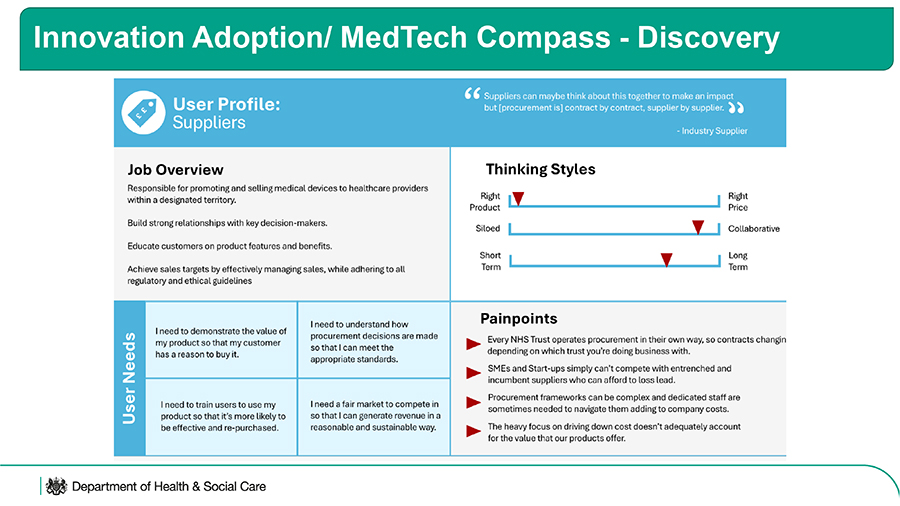
A major development currently in progress is the DHSC MedTech Compass, which is described as “a single source of information where there’s visibility of products within categories and information on the various attributes of those products”.
David acknowledged the challenges SMEs face in getting products in front of decision-makers across the country: “People may not be aware that actually you have a product because SMEs don’t have the resource to be able to go around the whole country to make everyone aware.”
The Compass aims to not only showcase available technologies but also introduce a ‘passporting’ function to reduce repetitive data submissions about the same technologies to NHS trusts. Having completed its discovery phase, the project is now entering its alpha design stage this summer, with beta testing expected in 2026.

Crucial to both the Compass and the wider ambition for smarter regulation and procurement is a Product Information Management (PIM) system. As David noted: “We don’t have a single version of truth in terms of medical devices.” Poor data quality is hampering post-market surveillance regulatory requirements and innovation uptake.
The PIM is now entering its beta build phase. A private beta involving industry and health partners will follow shortly, ahead of a full public launch in January 2026. David stressed that the PIM will underpin future initiatives, including a more “risk-proportionate” regulatory approach from MHRA.
On the topic of the Part IX Drug Tariff, David acknowledged its complexity: “I describe Part IX like an onion. You peel a layer, and then suddenly another layer appears”. After extensive work to modernise categories and introduce logical groupings, a new scoring framework will be implemented this month.

A new temporary listing process will allow products with emerging evidence to be included on the tariff while further data is collected. David also flagged future work on local formularies, noting the lack of national guidance and the inconsistent practices this leads to: “There are certain parts of the country that [suppliers] don’t bother engaging with because of the approach that they take”.
A forthcoming report from National Voices, drawing on input from over 650 patients, will help ensure future categorisation and procurement processes better reflect patient priorities and lived experiences.