- Back
- Back
- Back
- Back
- Back
- Back
- Back
- Back
- Back
- Back
Last Updated on 28/07/2026 by Samantha Lewis
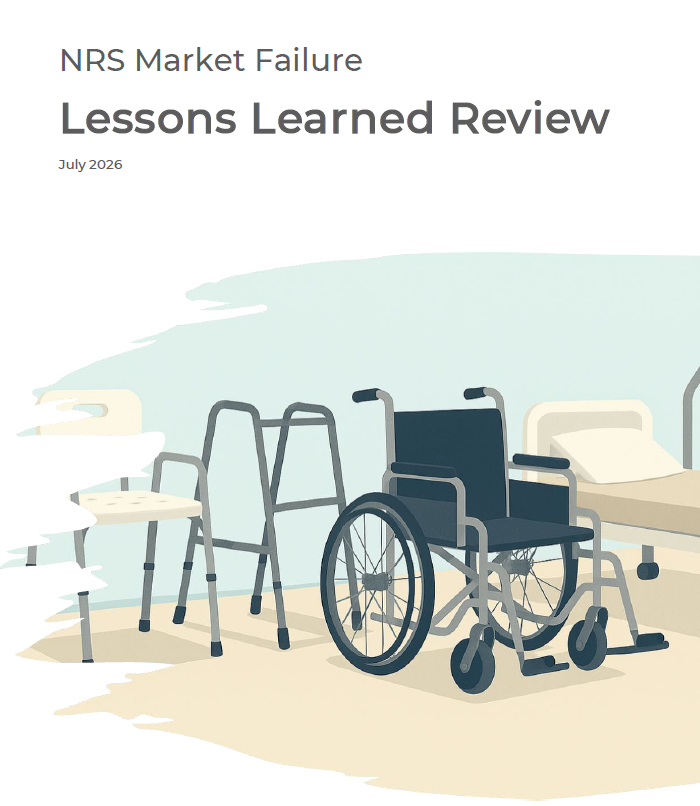
The collapse of NRS Healthcare in August 2025 was one of the most significant disruptions the community equipment and Technology Enabled Care (TEC) sectors have faced in recent years. The newly released NRS Market Failure: Lessons Learned Review sets out how the failure unfolded, how the system responded, and what must now change to protect services that people rely on to live independently and safely at home.
The review, commissioned by Partners in Care and Health and delivered by John Campbell, ARCC., makes clear that NRS’s collapse was not caused by a single event. It reflected a combination of structural pressures, including weak financial resilience, rapid expansion, unsustainable pricing models, insufficient oversight, the impact of a major cyber-attack in 2024, and leadership instability.
As one of the largest suppliers in the market, NRS’ failure created immediate risks to continuity of care, hospital flow, equipment supply and user safety.
For BHTA members, the report is particularly important because it recognises the central role of the wider supply chain. Manufacturers, distributors, service suppliers, TEC organisations, and SMEs were all affected. Some suppliers were left carrying significant unpaid debts, while the wider market has had to absorb rapid changes in demand, risk, and operating expectations.
BHTA CEO, David Stockdale, said: “We welcome this important report and thank the Local Government Association, Partners in Care and Health, ADASS and everyone involved for the considerable work that has gone into reviewing the lessons from the NRS market failure. The findings rightly recognise that community equipment services are critical to the health and care system and that a more resilient, sustainable approach is needed. We now have a real opportunity to turn these lessons into meaningful action. BHTA and our members stand ready to work with commissioners, government and partners across the sector to help deliver the reforms needed to strengthen community equipment services for everyone who relies on them.”
Community equipment must be treated as critical infrastructure
The report’s central message is that community equipment and TEC are not peripheral services. They are essential infrastructure within health and social care. They support hospital discharge, prevent avoidable admissions, enable independent living, reduce pressure on unpaid carers, and help people remain safe at home. When they fail, the consequences are felt across the whole system.
BHTA strongly supports the report’s call for a shift away from short-term, cost-driven procurement towards models that properly recognise value, resilience, quality, and outcomes. Too often, procurement has prioritised lowest price over long-term sustainability, innovation, and service resilience. The review warns that thin margins, rigid contracts, and limited transparency can undermine the stability of services that are vital to people’s lives.
The market needs stronger oversight and earlier warning systems
One of the most significant lessons is the need for better market oversight and early warning systems. Warning signs were visible before NRS entered liquidation, including supplier payment delays, stock availability issues, performance deterioration, and growing financial pressure. However, these indicators were not consistently captured, shared or escalated.
The review recommends stronger mechanisms for commissioners to gather intelligence from suppliers, prescribers, and frontline practitioners, including confidential reporting routes and routine supply chain monitoring. It also identifies a role for sector bodies, including BHTA and TSA, in supporting market intelligence, escalation and constructive sector dialogue.
BHTA welcomes this recommendation and stands ready to help create safe, structured channels for early warning and engagement.
Data access and continuity planning must be strengthened
Data access was another serious barrier during the NRS collapse. Commissioners and incoming suppliers often lacked complete and accurate information about service users, equipment locations, maintenance histories, and planned preventative maintenance. Future contracts must ensure commissioners can access essential operational data quickly and safely in the event of supplier distress or failure.
Suppliers and commissioners must work in partnership
A further theme is that arms-length contract management is not sufficient for services of this importance. Outsourced models can work well, but only where they are based on partnership, transparency, realistic pricing, and active oversight. Commissioners and suppliers must work together earlier and more openly when designing services, testing assumptions and assessing financial viability.
BHTA’s role
The review acknowledges the positive role played by BHTA and TSA during the response to the NRS failure, particularly in bringing stakeholders together, sharing information, and supporting suppliers affected by the disruption.
The BHTA will continue to work with members, commissioners, local authorities, NHS partners, ADASS, PCH, TSA, and government to help turn the lessons from this review into practical action and to support the development of a more resilient and sustainable market.
A moment for reform
The NRS failure was a disruptive and difficult time for all involved. However, it also provides an important opportunity to rethink how community equipment and TEC services are commissioned, governed, and supported.
The review is clear that without reform, the system remains vulnerable to future provider failure.
Community equipment and TEC services play a vital role in prevention, independence, hospital discharge, and integrated care. They must be commissioned and managed as essential services, with the right balance of quality, resilience, innovation, and value.
BHTA stands ready to work with partners across the sector to help turn the lessons from this review into practical action.
Read the full report online here